
 1 month ago
29
1 month ago
29
For years, Strategy’s Bitcoin playbook had one unwritten rule: never sell. That era appears to be over.
CEO Phong Le, when asked whether the company would sell any of its Bitcoin holdings, gave an answer that would have been heresy in the Michael Saylor era. Strategy prefers math over ideology. Translation: if selling Bitcoin makes shareholders richer on a per-share basis, the company will sell Bitcoin.
Six principles, one big pivot
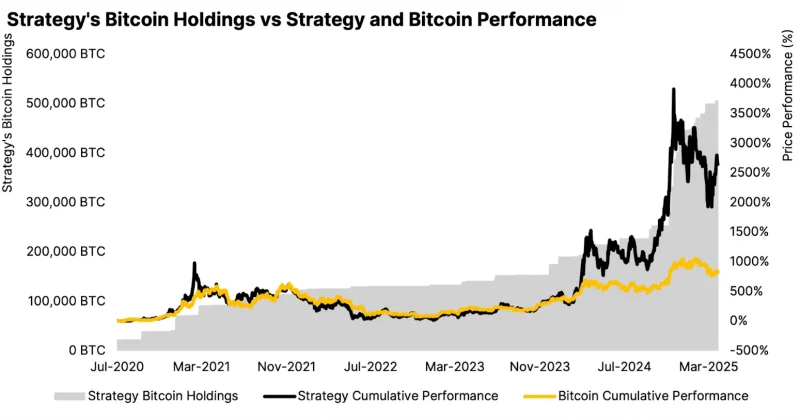
Strategy, the largest corporate holder of Bitcoin on the planet with approximately 818,334 BTC, has introduced six new market principles that fundamentally reshape how it thinks about its treasury. The core shift is deceptively simple: the company now prioritizes Bitcoin Per Share, or BPS, over total Bitcoin held.
The new framework explicitly allows for strategic Bitcoin sales when they benefit shareholders. That’s a significant departure from the quasi-religious HODLing stance that defined Strategy’s identity under Saylor, who stepped into an executive chairman role.
Le isn’t abandoning accumulation. The company still aims to reach 1 million BTC by year-end, fueled by $44B in planned capital raises. But the door to selling is now officially open, and it’s governed by spreadsheets rather than conviction.
Why the market didn’t panic
Bitcoin rose 2.3% to above $82,800 intraday following the announcement, which was tied to Strategy’s Q1 2026 earnings.
Strategy also revealed it has built a multi-year USD reserve specifically designed to protect its balance sheet and avoid forced BTC sales.
Le himself made some personal portfolio moves worth noting. He sold 3,299 shares of Strategy stock for $456K while simultaneously purchasing $250K in STRC preferred stock. The company characterized this as portfolio rebalancing.
The Saylor factor
Michael Saylor didn’t just adopt Bitcoin as a corporate strategy. He turned it into a personal brand, a philosophy, and something that looked an awful lot like a religion. His public statements consistently framed Bitcoin as a one-way trade, an asset you accumulate forever and never part with.
Phong Le’s language around Bitcoin sounds more like a CFO running scenario models than a prophet on a podcast. The six principles framework is essentially a governance structure for when and how to deploy or divest Bitcoin, something that never existed under the old regime because the old regime didn’t believe divestment was a valid concept.
Saylor remains executive chairman, but the strategic direction is now clearly in Le’s hands, and that direction involves treating Bitcoin as a financial instrument rather than an article of faith.
What this means for investors
Watch BPS as the new north star metric in Strategy’s earnings reports. If it trends up consistently, Le’s framework will be validated. If it doesn’t, the company will have abandoned the one narrative that made it unique without finding a quantitative replacement that holds up under scrutiny.
Disclosure: This article was edited by Editorial Team. For more information on how we create and review content, see our Editorial Policy.













 English (US) ·