
 2 hours ago
4
2 hours ago
4

content, reviewed by leading industry experts and seasoned editors. Ad Disclosure
A dispute with more than $85 million in total trading volume at stake has erupted on Polymarket after Strategy Inc. — formerly MicroStrategy — confirmed it sold 32 Bitcoin between May 26 and May 31, 2026, only for the prediction market to propose a “No” resolution on the grounds that public confirmation arrived one day after its stated deadline.
Strategy disclosed the 32 BTC sale — its first reported Bitcoin disposal since December 2022 — in a Form 8-K SEC filing submitted on June 1. The filing itself timestamps the transaction as “as of May 31, 2026, 4:00 p.m. Eastern Time,” with the sale executed at an average price of approximately $77,135 per coin across a six-day window ending May 31, generating roughly $2.5 million in proceeds directed toward preferred stock distributions, per the filing.
The amount represents approximately 0.0038% of Strategy’s 843,706 BTC treasury — a footnote in scale but a landmark in symbolism, given Michael Saylor’s repeated public declarations that he would never sell.
The Core Of The Dispute
The Polymarket market asked a straightforward question: did MicroStrategy sell any Bitcoin by May 31, 2026? Per Strategy’s own SEC filing, the sale ran from May 26 through May 31 — entirely within the window. The problem, per Polymarket’s proposed resolution, is that the Form 8-K was not filed until June 1.
The platform’s bulletin board stated that no information from MSTR filings, on-chain data, or credible reporting confirmed a Bitcoin sale within the market’s timeframe, and that “confirmation achieved outside of the market’s timeframe does not qualify,” per Polymarket’s official market page.
That framing has generated a furious response from traders who backed “Yes.” Their argument is equally straightforward: the market’s language refers to when the sale occurred, not when it was publicly announced — and the SEC filing explicitly places the transaction before the deadline.
Two separate proposed “No” resolutions were disputed by users, pushing the outcome to a binding vote by UMA token holders, which is expected to conclude within 48 to 96 hours, per Polymarket’s resolution rules. The market is now pricing “No” at 99.8 cents, per the Polymarket event page you provided.
As amplified by Wu Blockchain (@WuBlockchain) on X, community reaction has been severe — with some users declaring a total loss of faith in the platform and others warning that an incorrect resolution will permanently damage Polymarket’s credibility with serious traders.
A Deeper Problem With The Oracle
The UMA token-voting mechanism at the center of this dispute carries its own structural baggage, per a Wall Street Journal investigation published in May. The Journal found that in most disputed Polymarket markets, more than half of UMA voting power is concentrated in the ten largest wallets.
Approximately 60% of active UMA voters can be linked to live Polymarket accounts. And roughly one in five disputes has at least one voter with a financial stake in the contract they are ruling on — a direct conflict of interest baked into the system’s design.
Since the start of 2026, Polymarket has logged more than 1,150 disputed markets — already surpassing the full-year 2025 total, per the Journal’s reporting. The MicroStrategy market is the highest-dollar live test the platform has faced since the $237 million Zelenskyy dispute last year.
This development marks a critical moment for the nascent prediction market sector — and for Polymarket specifically, which is simultaneously navigating a formal congressional investigation, two federal insider trading arrests tied to its platform, and now a resolution dispute that has exposed a fundamental structural question: in a market built on transparency, who watches the oracle?
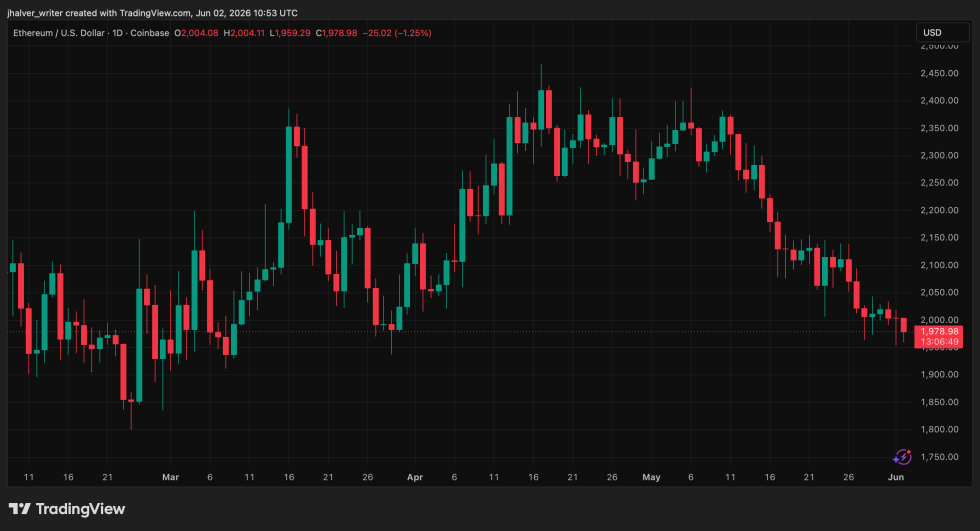
Cover image from ChatGPT, ETHUSD chart from Tradingview
Editorial Process for bitcoinist is centered on delivering thoroughly researched, accurate, and unbiased content. We uphold strict sourcing standards, and each page undergoes diligent review by our team of top technology experts and seasoned editors. This process ensures the integrity, relevance, and value of our content for our readers.












 English (US) ·