
 1 hour ago
3
1 hour ago
3

content, reviewed by leading industry experts and seasoned editors. Ad Disclosure
Given the prolonged waning price action, the Bitcoin network is starting to feel this bearish pressure, leading to a sharp decline in activity across the network. After a period of downward performance, the level of activity and participation within the network has significantly dropped below levels seen in previous bull market cycles.
How Bitcoin’s Network Usage Has Evolved Since 2021
While the Bitcoin price has been experiencing persistent downside action, its network performance is also exhibiting a notable decline. Currently, the network is telling a very different story from the one seen in past bull market cycles, especially the peak of the 2021 bull market.
Over the past few years, Bitcoin’s on-chain activity has experienced a substantial metamorphosis, ranging from changing transaction patterns to evolving investor behavior. According to data shared by Santiment, a popular market intelligence and on-chain data analytics platform, the BTC network was averaging roughly 1.12 million active addresses per day and nearly 489,000 new wallet addresses being created daily in May 2021.
However, as of Today, those figures have now dropped to approximately 624,000 active wallet addresses and 278,000 new wallet addresses generated per day, which represents declines of about 44% and 43%, respectively.
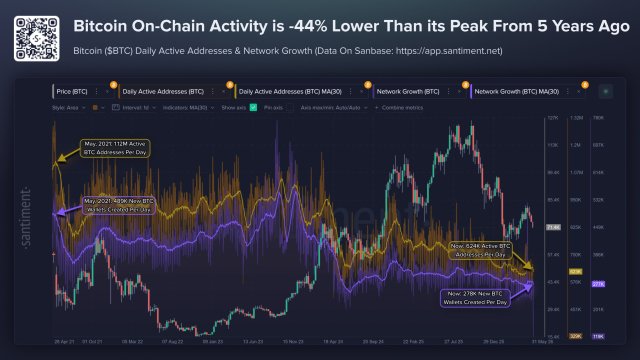 Source: Chart from Santiment on X
Santiment highlighted that active addresses are often used as a proxy for the number of unique participants transacting on the network. Meanwhile, the network growth calculates the creation of new wallet addresses that interact with BTC for the first time.
Together, these metrics suggest that Bitcoin is attracting fewer new participants and generating less day-to-day transactional activity than it did during the height of retail enthusiasm about 5 years ago. Despite the Bitcoin price remaining well above its 2021 levels for much of the current cycle, on-chain participation has not been quiet.
Key Drivers Are Spot ETFs And Institutional Investment Vehicles
These shifts imply that a new set of factors is driving the market, which could influence how analysts assess demand, network health, and upcoming price movements. One of the major reasons behind this may be the growing influence of the Spot Exchange-Traded Funds (ETFs) and institutional investment vehicles.
These allow investors to gain more exposure to BTC without directly moving coins on-chain or creating new wallets. At the same time, Santiment highlighted that many long-term holders have become increasingly passive, choosing to store their assets rather than transact frequently. As a result, the network is still very valuable but less active than it was in 2021 during the retail-driven craze.
Historically, this is not necessarily a bearish indicator as many may assume at first sight. Most times, volatility in either direction is what triggers BTC’s network activity to rise. Furthermore, this decline in activity is likely due to sideways movement and growing crowd interest in equities and precious metals as of late.
At the time of writing, the price of BTC was trading at $69,876, demonstrating a nearly 5% increase in the last 24 hours. Despite this decline, traders are showing increased interest in the asset, as evidenced by a more than 134% rise in trading volume over the past day.
Featured image from Pngtree, chart from Tradingview.com
Editorial Process for bitcoinist is centered on delivering thoroughly researched, accurate, and unbiased content. We uphold strict sourcing standards, and each page undergoes diligent review by our team of top technology experts and seasoned editors. This process ensures the integrity, relevance, and value of our content for our readers.
















 English (US) ·