
 1 hour ago
1
1 hour ago
1
More than $80 million has been wagered on a Polymarket market tied to Strategy’s Bitcoin sales, with the outcome now heading to a final dispute process after the company disclosed that it sold 32 BTC before the market’s May 31 deadline.
Summary
- A Polymarket market with more than $80 million in volume entered a dispute after Strategy disclosed a 32 Bitcoin sale that occurred before the May 31 deadline.
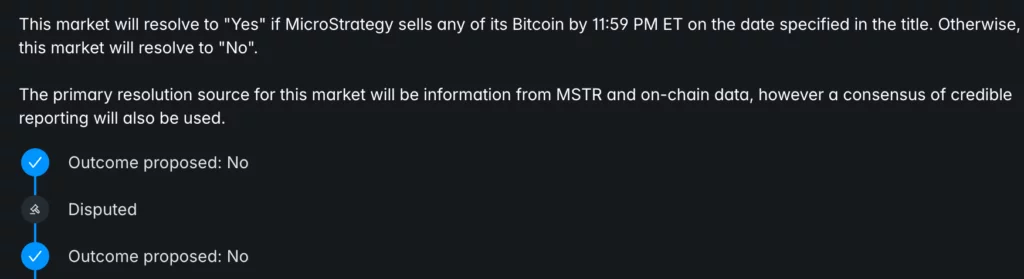
- Polymarket proposed a “No” resolution, arguing that confirmation of the sale was not publicly available within the market’s timeframe.
- The final outcome now rests with UMA tokenholders after users challenged the proposed resolution and questioned how the market’s rules should be applied.
Polymarket users have challenged the platform’s proposed resolution of a market that asked whether Strategy would sell Bitcoin by May 31, after the company revealed in a regulatory filing that it sold 32 BTC worth roughly $2.5 million between May 26 and May 31.
 Polymarket bet on MicroStrategy sales. Source: Polymarket.
Although the transaction took place within the period specified by the market, Strategy disclosed the sale on June 1. Based on that timing, Polymarket moved to resolve the market as “No,” arguing that confirmation of the sale did not emerge before the market’s deadline.
By Tuesday, trading activity on the market had exceeded $80 million as users continued to debate whether the result should depend on when the sale occurred or when it became publicly known.
In an update posted to the market page, Polymarket said confirmation achieved outside the market’s timeframe does not qualify for resolution purposes. The platform added that no information from Strategy, on-chain data, or a consensus of credible reporting confirmed a Bitcoin sale before the deadline expired.
Users push back against proposed outcome
Across the market’s comment section, several participants criticized the proposed resolution and argued that the underlying event occurred before May 31 regardless of when the company disclosed it.
One user wrote that Polymarket should “trade truth, not technicalities,” while another said the outcome had caused them to lose confidence in the platform. A separate commenter described the decision as “unbelievable.”
As the dispute continued, the market remained heavily priced in favor of a “No” outcome, with approximately 99.9% odds attached to that result despite objections from holders of “Yes” shares.
Because two proposed resolutions have already been disputed, the final decision now falls to holders of the UMA token, which powers the oracle system used by Polymarket to settle markets. According to the market’s rules, the review process can take up to two days.
 Source: Polymarket.
Polymarket noted that if no statement is issued by 12:00 a.m. UTC on Wednesday, the order book will be cleared.
The controversy emerged shortly after Strategy reported its first Bitcoin sale since 2022. The company, formerly known as MicroStrategy, disclosed Monday that it had sold 32 BTC while continuing to hold more than $60 billion worth of Bitcoin.
Strategy’s decision drew attention because the firm had long maintained that it would never sell its Bitcoin holdings. Following the disclosure on June 1, Bitcoin fell 2.5% to $70,815 within five hours, according to market data.
Other Strategy-related prediction markets asking whether the company would sell Bitcoin by June 30 and Dec. 31 have already resolved to “Yes” without disputes.
For participants in the May 31 market, however, the final outcome now depends on how UMA voters interpret the timing of confirmation versus the timing of the sale itself.
As previously reported on crypto.news, last year a separate Polymarket dispute emerged over a market asking whether Ukrainian President Volodymyr Zelenskyy would wear a suit during a specified period.
The market generated roughly $237 million in volume and eventually went to UMA tokenholders after participants disagreed over whether Zelenskyy’s military-style attire met the definition of a suit.
The case drew criticism from some users, who argued that subjective interpretations could influence market outcomes.















 English (US) ·