
 1 month ago
33
1 month ago
33
The global financial landscape is currently navigating a period of intense turbulence. On March 3, 2026, investors are closely watching the correlation between traditional equities and digital assets as a series of macro events shake confidence. With the US stock market showing signs of a potential "bloodbath," the question on every trader's mind is: will Bitcoin and the broader crypto market be the next to tumble?
Historically, cryptocurrencies have often moved in tandem with high-risk tech stocks. As major indices like the S&P 500 and Nasdaq face downward pressure from geopolitical conflicts in the Middle East and ongoing tariff uncertainties under the Trump administration, the "digital gold" narrative is once again being put to the test.
Will Crypto Prices Crash with the Stock Market?
Yes, a significant crash in the US stock market typically leads to a liquidity crunch that forces investors to sell off speculative assets, including cryptocurrencies. When institutional investors face margin calls in their equity portfolios, they often liquidate their most liquid and profitable assets—frequently Bitcoin and Ethereum—to cover losses.
Current Market Snapshot (March 3, 2026)
As of today, several key tech giants are experiencing a mixed but volatile session:
- NVIDIA (NVDA): ~$182.48 (+2.99%) – Showing resilience due to AI demand.
- Microsoft (MSFT): ~$398.55 (+1.48%)
- Alphabet (GOOGL): ~$306.52 (-1.68%) – Feeling the heat of broader market jitters.
- Apple (AAPL): ~$264.72 (+0.20%)
While some tech stocks are holding green, the broader sentiment is fragile. Reports indicate that over $1 trillion was recently wiped off global markets in a single day due to fears of a trade war and escalating conflict in the Middle East.
Why are Cryptos Crashing: Understanding the Risk
The current risk of a crypto crash stems from a "perfect storm" of three primary factors:
1. Geopolitical Escalation
The assassination of high-ranking leaders in the Middle East has sent shockwaves through the global economy. This has led to a surge in oil prices and a "risk-off" sentiment. In such environments, investors flee to safe havens like physical gold, often at the expense of Bitcoin.
2. Tariff Uncertainty
The second year of the Trump administration has been marked by aggressive trade policies. While the Supreme Court previously challenged certain tariffs, the administration's push for a 15% global levy continues to create uncertainty. For companies relying on global supply chains, this means higher costs and lower earnings, which eventually drags down the stock market and its "digital twin," the crypto market.
3. The "AI Bubble" Fatigue
Much of the 2025-2026 rally was driven by generative AI. However, analysts are starting to worry about the actual profitability of these ventures. If the AI bubble bursts, the Nasdaq—and by extension, the crypto market—could see a correction exceeding 20%.
Technical Analysis: BTC and ETH Levels to Watch
If the stock market sell-off intensifies, we must look at critical support levels for the leading cryptocurrencies.
- Bitcoin (BTC): BTC is currently hovering around $65,000. A failure to hold the $62,000 support could lead to a rapid descent toward $55,000.
- Ethereum (ETH): ETH remains sensitive to DeFi activity. A drop below $2,000 would signal a deeper bearish trend for altcoins.
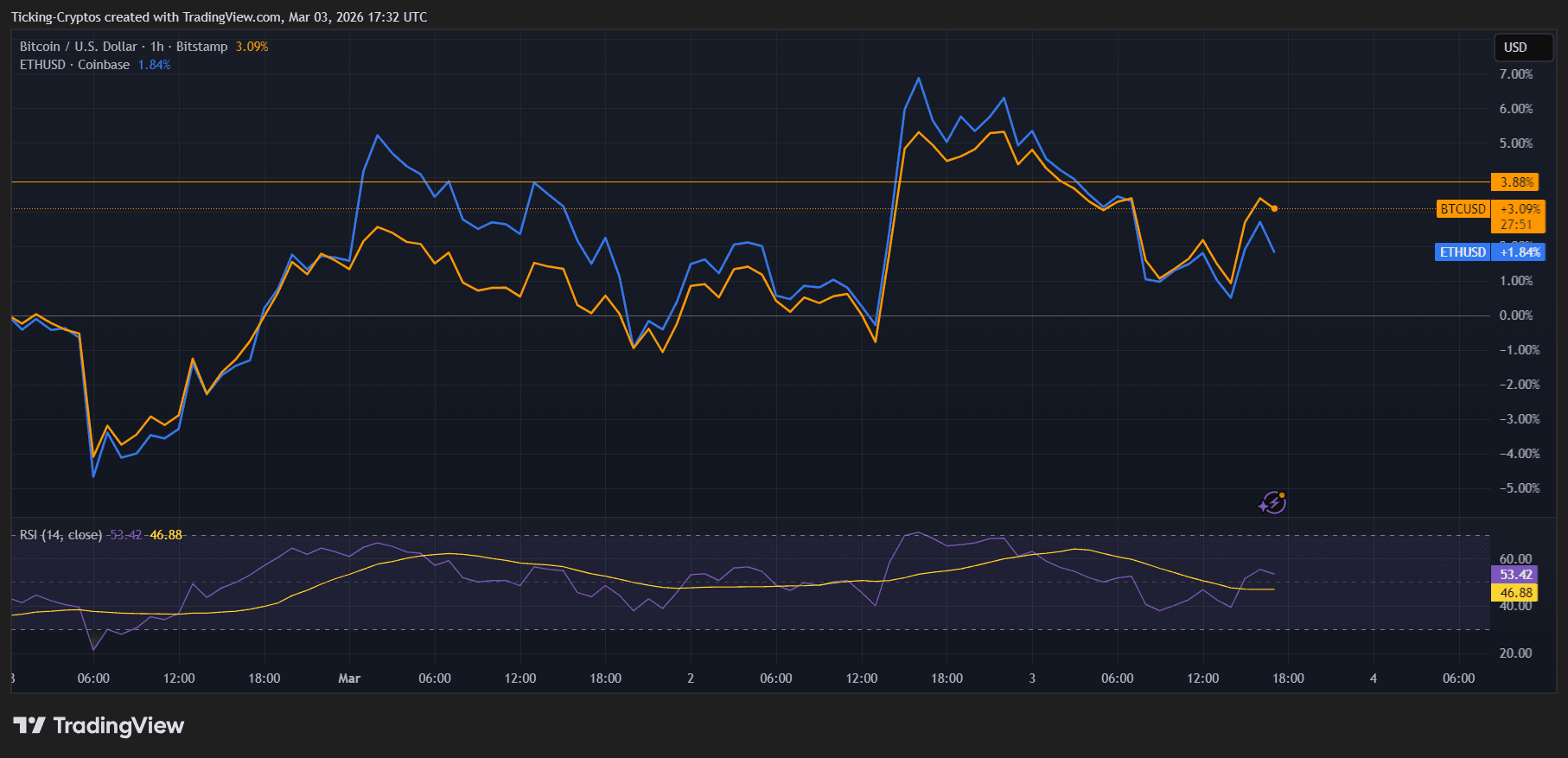 Bitcoin (orange) and Ethereum (blue) chart
Conclusion
While Bitcoin has shown flashes of independence, it remains deeply tethered to the global macro environment. A stock market crash in 2026 would likely trigger a temporary but sharp crypto price crash as liquidity exits the system. However, for the long-term believer, these "bloodbaths" have historically provided the best accumulation zones.
















 English (US) ·