
 2 hours ago
2
2 hours ago
2
The US Commodity Futures Trading Commission (CFTC) is suing New York, Connecticut, Arizona and Illinois for applying state-level gambling laws to prediction markets.
The move follows a heated legal argument between states and companies like Kalshi, as they fight over who has jurisdiction to regulate the “prediction” platforms. Other states have issued cease-and-desist letters or sued the prediction markets.
Strategy bought over 56,000 Bitcoin. One of its last purchases in April was funded by a $250 million sale of the company’s common stock.
In France, prosecutors have charged 88 alleged “wrench attackers” accused of attempting to extort cryptocurrencies from investors through violence.
Here’s April by the numbers:
US federal government sues four states for legal action on prediction markets
On April 24, the CFTC sued the state of New York to stop it from applying state-level gambling laws to prediction markets like Kalshi and Polymarket.
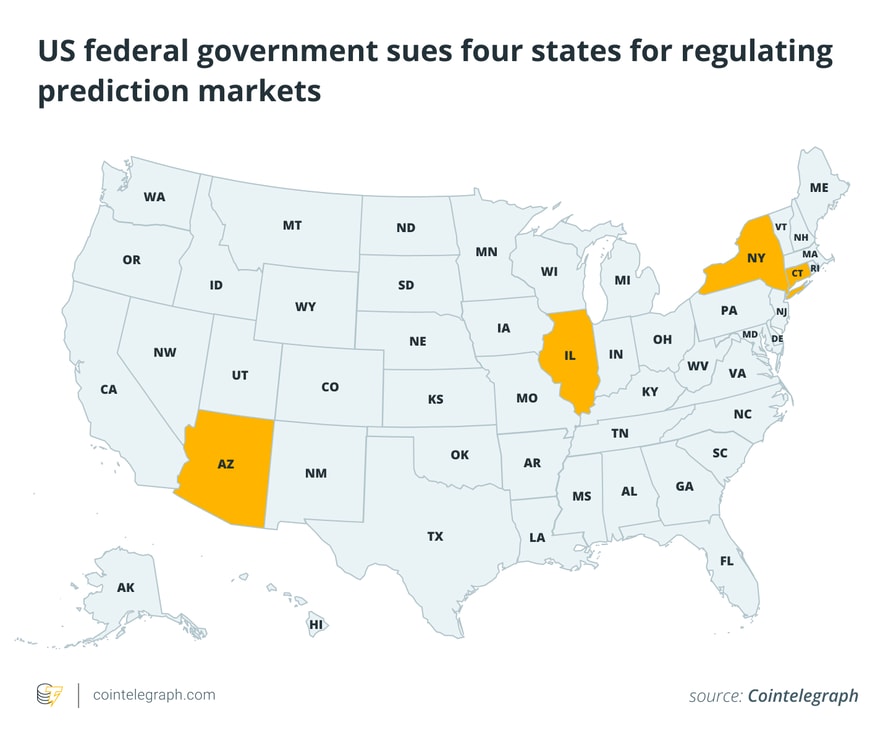
New York joins Connecticut, Arizona and Illinois as states targeted in federal actions asserting the CFTC’s authority over prediction markets.
States around the US are attempting to rein in gambling markets, namely Kalshi and those offered by Coinbase and Robinhood. States argue that gambling laws should apply to what are essentially sportsbooks, while the prediction markets claim they offer a form of swap contracts regulated solely by the CFTC.
An appellate court in New Jersey has ruled in favor of the CFTC and prediction markets’ interpretation. But a similar case in Nevada could fall in the other direction, making the issue ripe for the Supreme Court.
Strategy stacks 56,325 Bitcoin while STRC sits on sidelines
Strategy, the software company-cum-Bitcoin investment vehicle run by Michael Saylor, acquired 56,325 BTC in April.
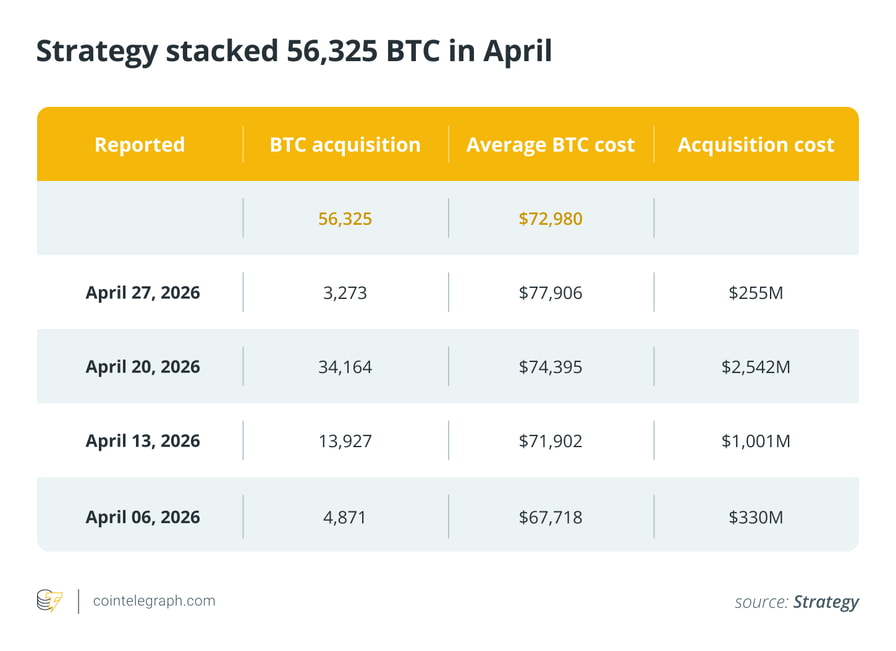
The company bought 3,273 BTC (about $249 million) on Monday through common stock (MSTR) sales. According to a filing with the US Securities Exchange Commission, Strategy sold 1,451,601 Class A common shares and used the proceeds to buy Bitcoin.
STRC, Strategy’s perpetual preferred stock, did not raise any capital in that filing. Strategy has become increasingly reliant on the short-duration high-yield credit product for capital raises to buy Bitcoin.
After a lackluster month for Bitcoin in March, when the company’s BTC holdings were briefly in the red, Strategy is showing nearly 1% on its Bitcoin holdings as of Tuesday.
Global tokenized RWAs surpass $30 billion in distributed asset value
The total distributed asset value of tokenized real-world assets (RWAs) surpassed $30 billion for the first time in April.
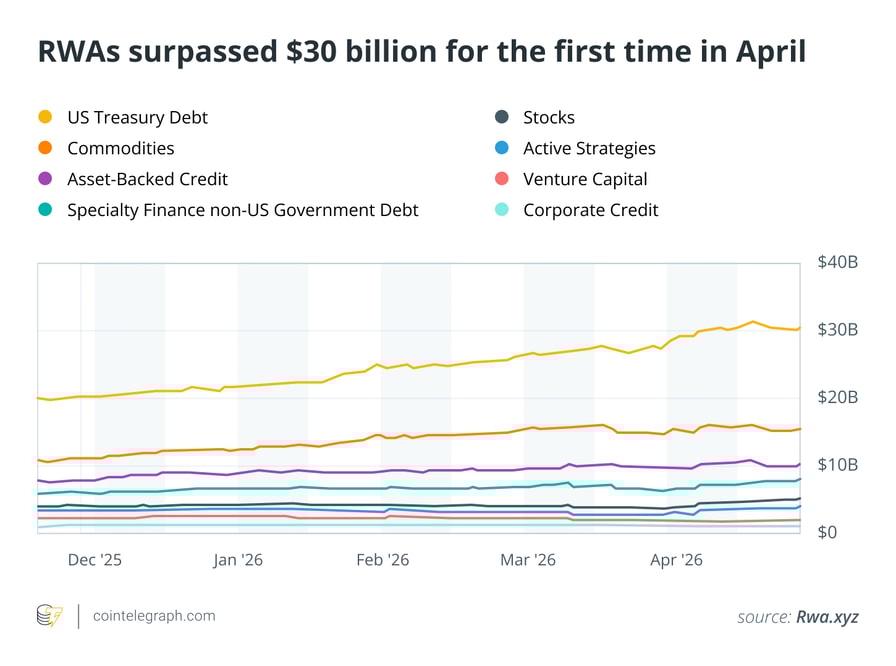
A Chainalysis report on the growing market said that institutions experimenting with tokenized RWAs are moving beyond their pilot programs and beginning to view onchain infrastructure as a practical solution.
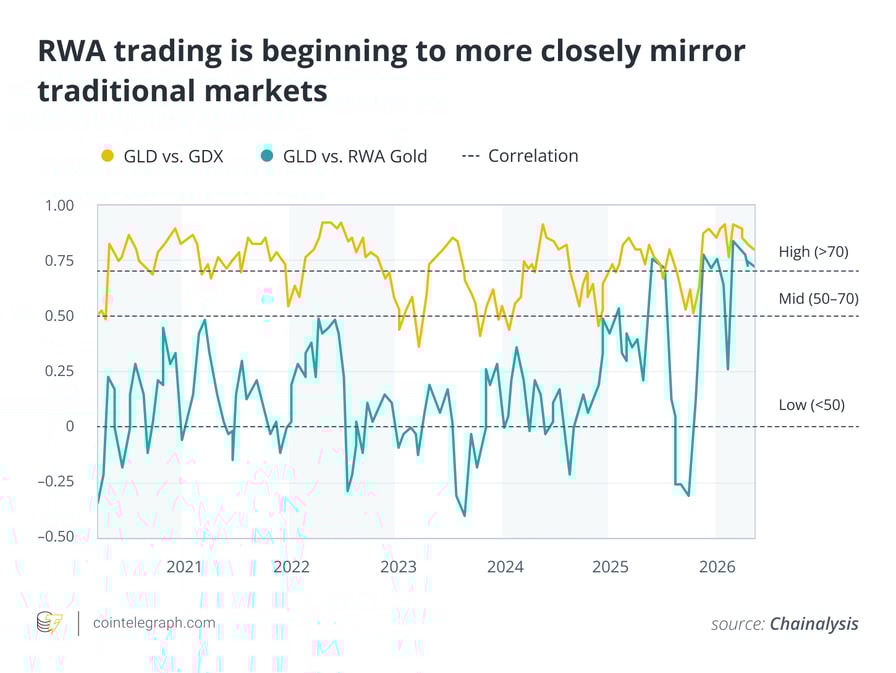
This increased institutional participation and liquidity have led trading patterns in RWA markets to more closely mirror traditional finance, including responses to signals such as inflation and geopolitical risk.
Five wrench attacks in April, French prosecutors charge 88 suspects
The trend of physical attacks on crypto holders continues, with five recorded incidents in April. Four happened in France, while the fifth occurred in England, according to Casa founder Jameson Lopp's repository.

The increasing popularity and publicity of crypto traders and executives has led to a surge in kidnappings and ransom attacks on prominent figures in the industry.
There have reportedly been 47 attacks in France alone this year. One executive from crypto wallet firm Ledger, which is based in the country, claims that this is because of the law requiring entrepreneurs to register their names and addresses.
France has cracked down on offenders. On April 24, the National Organized Crime Prosecutor’s Office announced that it charged 88 offenders across 12 federal districts.
Crypto executives are spending more on personal safety, and boutique insurance firms have even begun offering kidnap and ransom policies amid skyrocketing demand.
Related: Crypto execs ramp up security as wrench attacks increase
Two US states now ban crypto kiosks, more move against Bitcoin ATMs
US states have been cracking down on crypto ATMs and kiosks amid scam and money laundering concerns. In April, Tennessee became the second state to ban them outright.
On April 13, Tennessee Governor Bill Lee signed House Bill 2505, making the installation of a cryptocurrency kiosk a Class A misdemeanor.
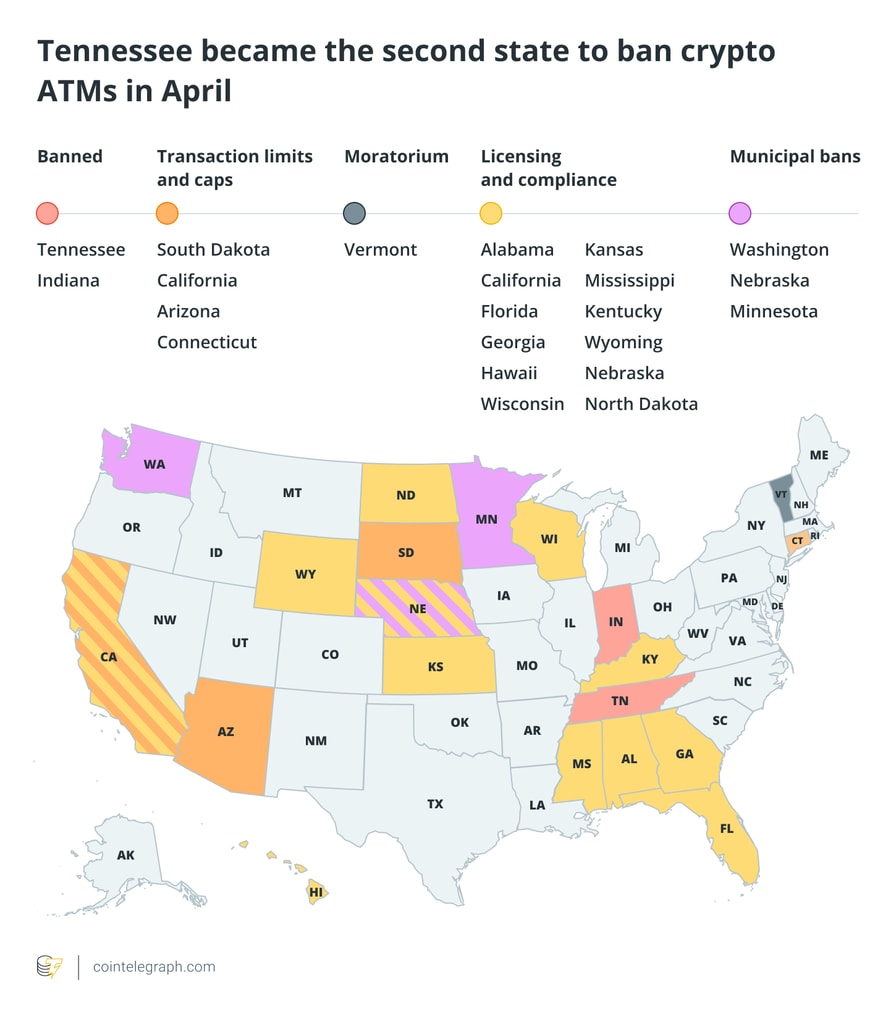
According to Coin ATM Radar, there are 560 crypto ATMs in the state. Operators and businesses hosting them will need to shut them down by July 1, or face up to 11 months and 29 days in prison and a $2,500 fine.
Indiana banned crypto ATMs last month. A number of other states have introduced strict licensing requirements and regulations. Vermont has a moratorium on crypto kiosks, and many cities have issued municipal bans on the devices.
The American Association of Retired People has particularly supported and lobbied for stricter controls, citing the kiosks proliferation in scams targeting senior citizens.
Cointelegraph is committed to independent, transparent journalism. This news article is produced in accordance with Cointelegraph’s Editorial Policy and aims to provide accurate and timely information. Readers are encouraged to verify information independently.















 English (US) ·