
 2 hours ago
2
2 hours ago
2
Here’s the simplest way to prove a digital file was yours, and existed at a certain point in time. A new service called “Timestamped” leverages one of blockchain’s most useful built-in features to provide verifiable proof of a point in time. Who’s it for? Absolutely anyone who needs permanent proof, like lawyers, content creators, designers, researchers, or musicians. Once it’s verifiably yours, no one can ever claim otherwise.
Observers have long noted that a proof-of-work (PoW) blockchain like Bitcoin’s could be the ultimate timestamp server. In fact, the second-ever Bitcoin user, Hal Finney, pointed it out in one of his first conversations with Satoshi Nakamoto. The contents of any file, of any size, can be hashed and included in a Bitcoin address, which then sends a single, minimal transaction of 1 cent (or less).
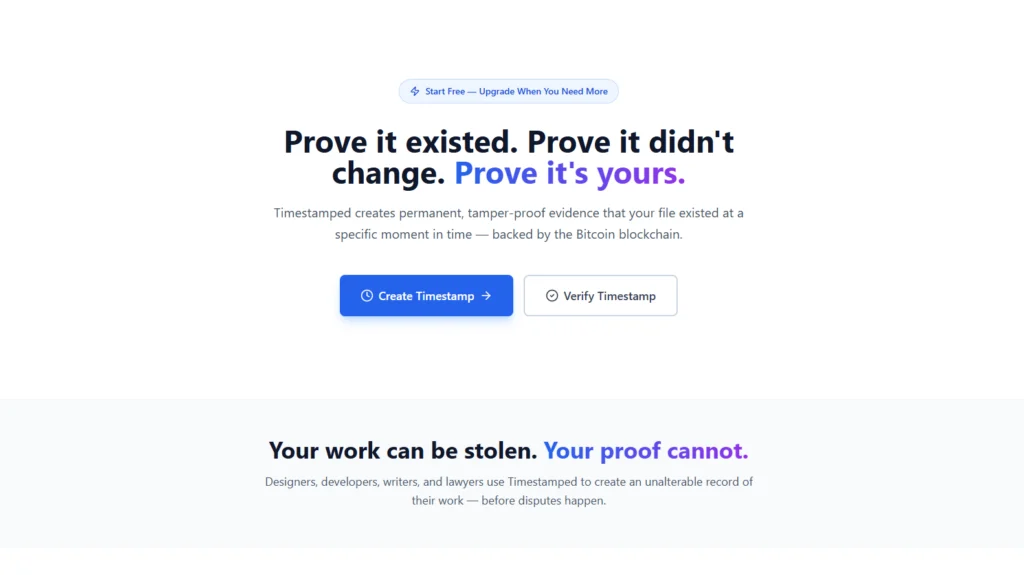
The service’s main page sums up the key selling points succinctly: “Prove it existed. Prove it didn’t change. Prove it’s yours. Timestamped creates permanent, tamper-proof evidence that your file existed at a specific moment in time.”
It’s useful for those who create digital files and for those who wish to store others’ evidence. One other example would be verifiable records of dashcam footage showing exactly when it was shot and that nothing has been altered since.
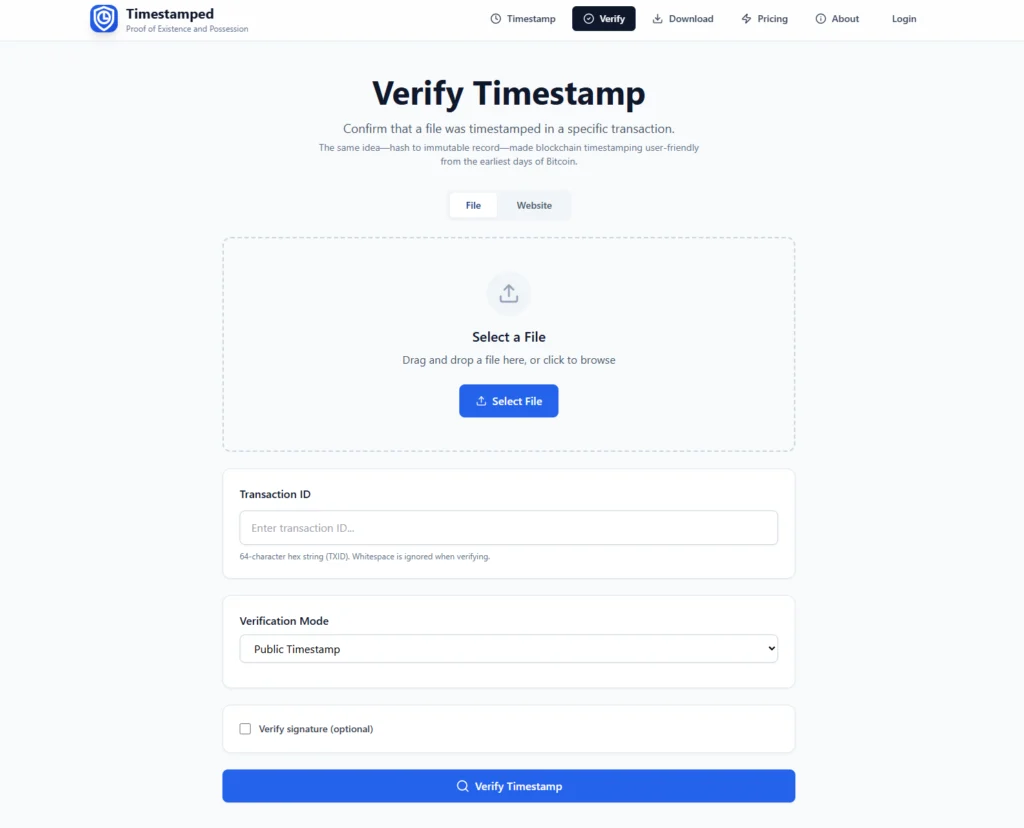
Timestamped can store the actual files too, but that’s optional. It makes them verifiable by hashing the file’s contents and turning the hash into a BSV transaction. Once that’s done, you can verify the file’s permanent timestamp by attaching it to the “verify” page along with its Transaction ID. If they match, the file is stamped and genuine. If the file has been altered in any way, it won’t verify.
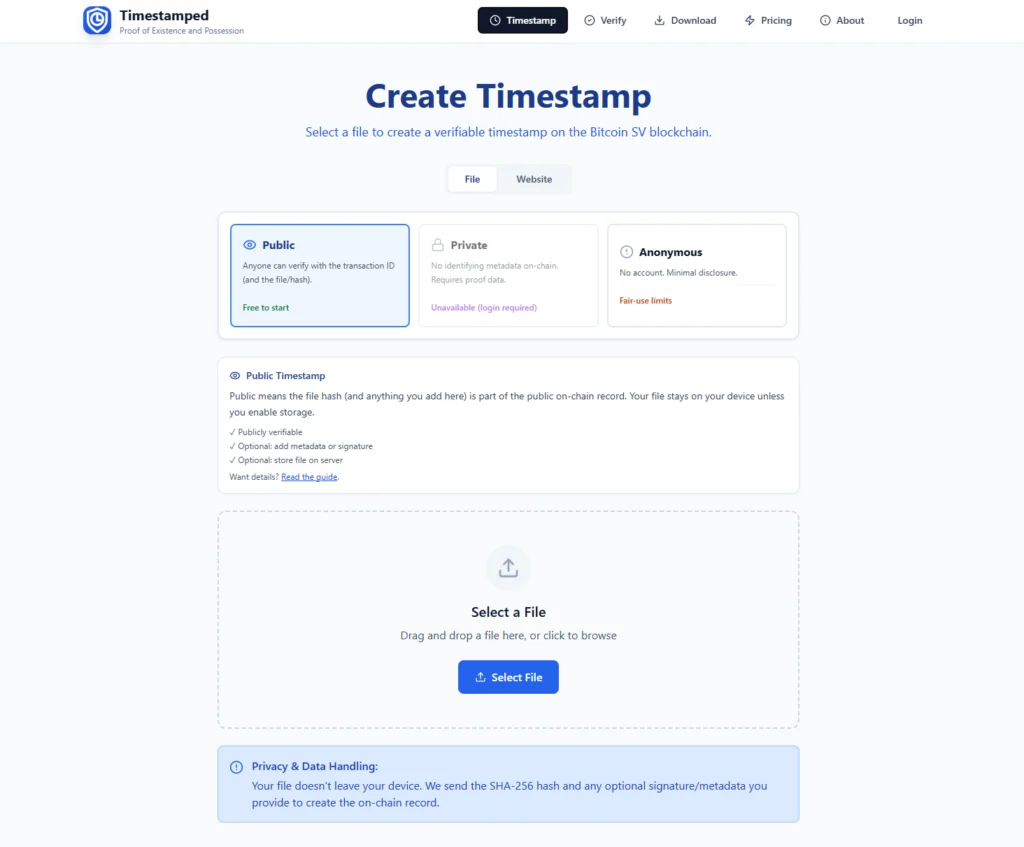
It works the same for files or web pages (at least, a web page at any given point in time). Users can add metadata or a signature to the transaction and set the transaction information to public, private, or anonymous. There are other conditions to use the anonymity feature. Timestamp’s online app only makes the hash and sends the transaction to the blockchain; the files themselves don’t leave the user’s computer (unless they’re also using the online storage option).
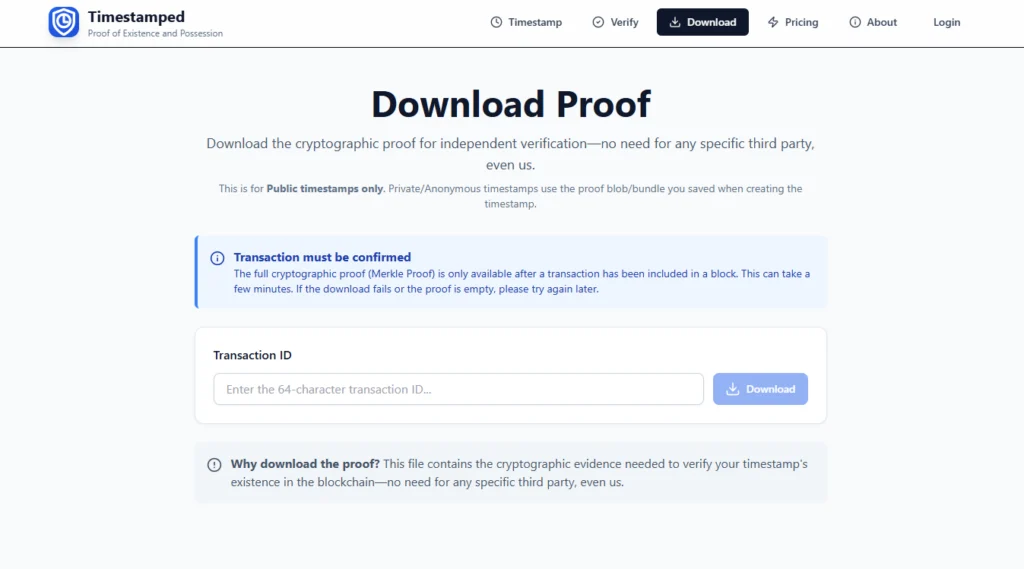
Proofs of existence can be downloaded and saved as a file. They include the raw transaction data and Merkle proof to keep as a permanent record.
Timestamped comes from developer Meysam Rezaei, who also built the Bitails explorer and data site to monitor data on BSV blockchain.
“By adding the digital signature,” Rezaei told CoinGeek, “you can make a strong argument about content authorship/ownership—or by timestamping a URL/website, you can add proof and verify any changes or the integrity of the content.”
Timestamped sidesteps the “onboarding issue” that plagues many BSV—and other blockchain-based services—by not requiring its users to hold any digital asset or wallet. This issue has long posed new-signup barriers for blockchain projects: not only does a new customer need to create an account with the service itself, but they also need to acquire units of the blockchain’s native asset (usually from an exchange or another third party) to pay network fees. It’s a problem most frequently encountered by stablecoin users who have a balance in USDC or Tether, but discover they can’t actually send it anywhere without paying network fees in ETH, SOL, etc.
The model here looks more like a traditional online business model: pay a subscription fee in USD, and Timestamped handles transactions and network fees. There’s a free tier with up to 10 transactions per day and 10 MB of storage (for 30 days). There are three paid tiers, with Timestamped recommending the mid-tier plan, which supports up to 500 transactions per day and 1,000 MB of storage (for 365 days). The storage conditions apply only to users who need that option, as the transaction proof itself remains available forever.
Although the service is available to anyone, it’s aimed mainly at businesses that need verifiable online storage for many files and prefer the accounting simplicity of USD-denominated payments. It’s a simple idea combined with a very easy, user-friendly interface, resulting in a service that could save someone’s day in high-stakes situations.
Watch: It’s time for corporates to turn to public blockchain solutions














 English (US) ·