
 1 month ago
30
1 month ago
30
SpaceX stock has climbed after President Donald Trump said he believes Elon Musk may contribute SpaceX shares to the Trump Accounts program, adding to optimism ahead of the company’s expected Nasdaq-100 inclusion.
Summary
- SpaceX stock rose 3% after Donald Trump said he believes Elon Musk may support the Trump Accounts program with SpaceX shares.
- Investors continue to watch SpaceX’s expected Nasdaq-100 entry on July 7, which JPMorgan estimates could trigger about $4.3 billion in passive buying.
- ARK Invest expanded its SpaceX holdings, while Citadel Securities warned that higher interest rates could pressure high-growth stocks.
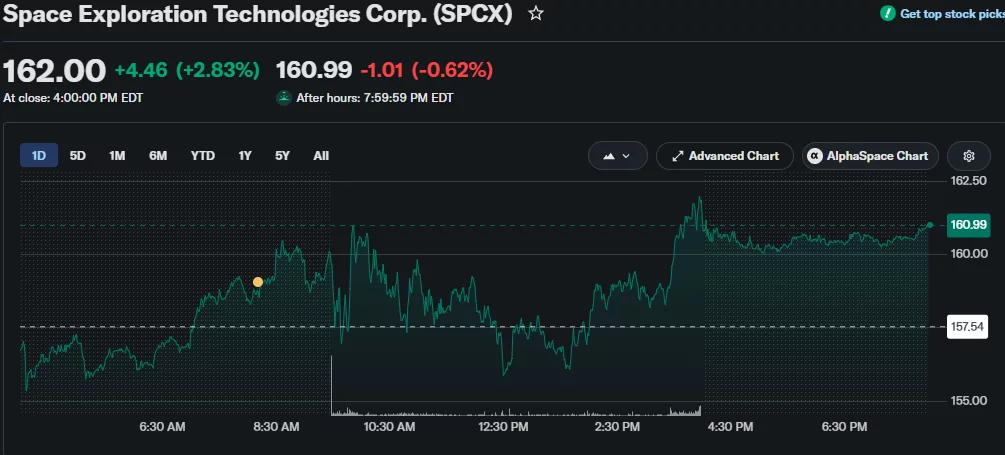
According to market data, SpaceX ticker SPCX rose about 3% to close at $162 on July 3 after recovering from an intraday low near $155, as buyers stepped in following early selling pressure. The advance came as risk assets also strengthened, with Bitcoin, Ethereum, Solana, and XRP trading higher during the session.
 Source: Yahoo Finance
Trump comments add to bullish sentiment
Speaking in a Thursday interview with CNBC’s Joe Kernen, President Donald Trump said he believes Elon Musk could donate SpaceX stock to the Trump Accounts initiative, although he noted he had not recently spoken with the billionaire.
Trump described his relationship with Musk as positive and pointed to support from other business leaders, including Michael Dell and Micron, for the children’s investment program.
The Trump Accounts initiative creates investment accounts for children and permits contributions from outside parties. Under U.S. Treasury guidelines, publicly traded shares may be contributed to the accounts. However, neither Musk nor SpaceX has announced any commitment to donate stock, leaving Trump’s remarks as an expectation rather than a confirmed plan.
Trading activity showed buyers defending the $157.50 support area before pushing the stock above $160 later in the session. Afternoon buying accelerated as volume increased toward the close, lifting SPCX near intraday resistance around $162.50. After-hours trading eased to roughly $161, indicating some profit-taking after the rally while the stock continued to hold above the psychological $160 level.
Nasdaq-100 inclusion and institutional buying remain in focus
Investor attention has also stayed on SpaceX’s expected addition to the Nasdaq-100 on July 7. According to Reuters, JPMorgan estimates the index inclusion could trigger roughly $4.3 billion in passive buying as exchange-traded funds and index funds tracking the benchmark purchase SpaceX shares to match the index.
The company has already entered the Russell 1000 Index, while remaining ineligible for the S&P 500 because the index requires newly qualified companies to wait 12 months before consideration, according to Reuters.
Institutional buying has continued ahead of the index change. On June 22, Cathie Wood’s ARK Invest purchased 210,121 SpaceX shares across its ARKK, ARKQ, ARKW, and ARKX funds. Based on SpaceX’s closing price that day, the purchases were worth about $32.5 million.
ARK added another 45,728 shares across the same funds on June 26, a purchase valued at roughly $7 million, extending the firm’s exposure as the stock continued to attract institutional interest.
Despite the positive catalysts, Citadel Securities has warned that investors may be underestimating the Federal Reserve’s commitment to keeping inflation under control.
According to the firm’s report, interest rates remaining higher for longer could pressure high-growth companies and other risk-sensitive assets, while the AI-driven rally could face additional obstacles from softer demand, weaker investment returns, and increasing political and regulatory scrutiny.
Still, SpaceX ended the session on stronger footing as investors balanced Trump’s comments, expected index-driven demand, and continued institutional accumulation against the prospect of a more restrictive interest-rate environment.












 English (US) ·