
 1 month ago
32
1 month ago
32
Robinhood’s new blockchain is not wasting any time proving itself. Developers deployed over 13,900 smart contracts on Robinhood App Chain in the week following its public mainnet launch on July 1, 2026, suggesting the chain has attracted genuine building activity rather than the usual ghost-town silence that greets most new network launches.
What Robinhood Chain actually is
Robinhood Chain is an Ethereum Layer 2 built on Arbitrum’s tech stack. It is EVM-compatible, which means any developer already comfortable with Ethereum tooling can deploy contracts using familiar frameworks like Foundry or Hardhat without relearning anything from scratch.
Block times sit at 100 milliseconds, which is fast enough to handle the kind of real-time price sensitivity that financial applications demand.
One design choice worth noting: there is no native chain token. Gas fees are paid in ETH. This is a deliberate move away from the standard L2 playbook, where launching a proprietary token generates immediate revenue but also adds friction for users who have to acquire yet another asset just to interact with the network.
The chain also positions itself as “AI-native,” framing artificial intelligence as a first-class component of its architecture alongside traditional finance and DeFi applications.
Day-one integrations and the RWA angle
On launch day, the chain went live with Chainlink integrations designed specifically to support stock tokenization, with initial offerings covering shares in NVDA, GOOG, and AAPL.
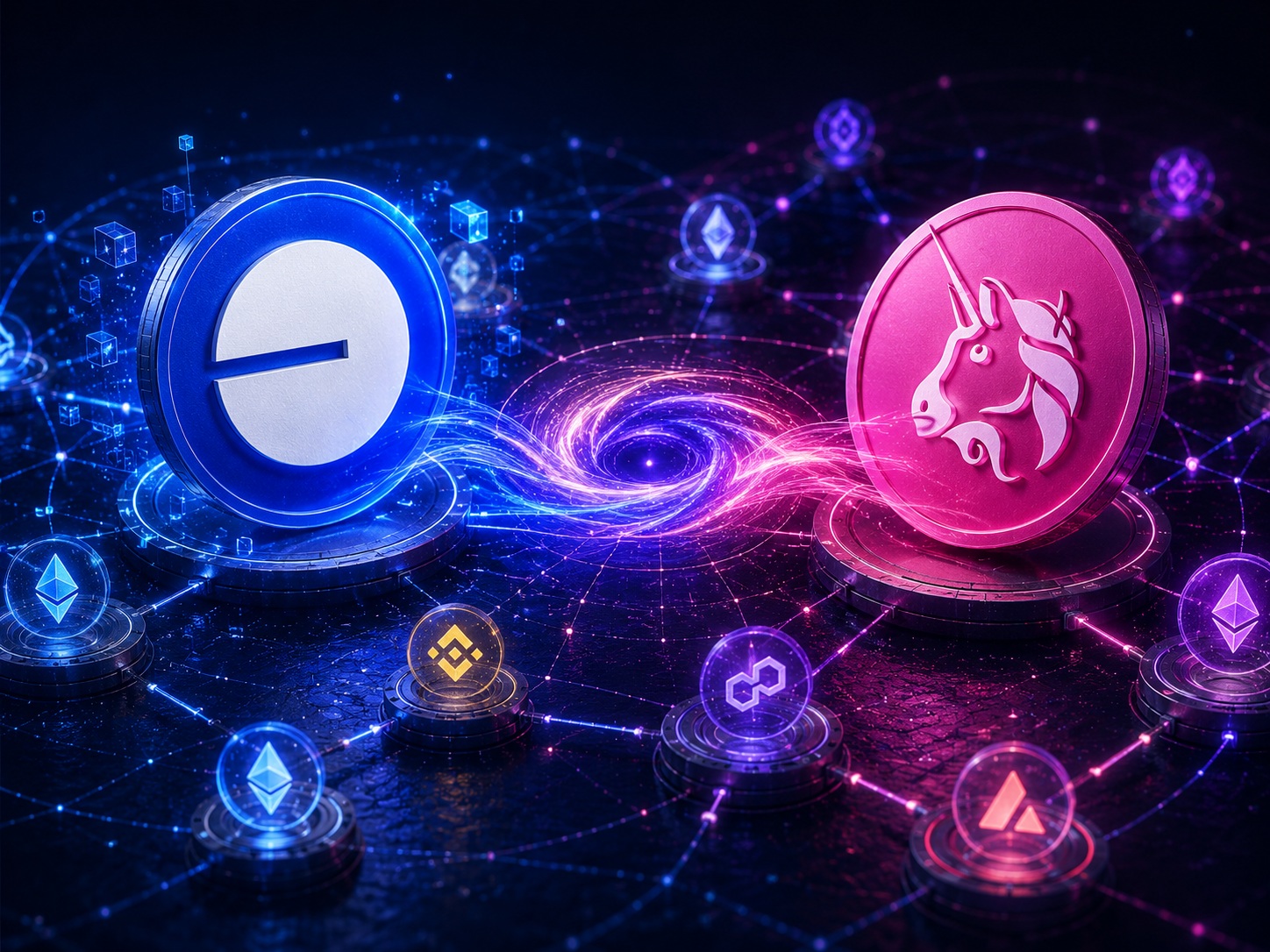
Uniswap deployed a public liquidity automated market maker on the chain at launch, providing the baseline infrastructure needed for token trading. Pleiades, a proprietary trading venue, also went live as a day-one partner. Canonical contracts include WETH and USDG, covering the basic building blocks any DeFi ecosystem needs to function.
The Chainlink partnership handles the oracle layer, providing the off-chain price feeds that on-chain stock tokens require to stay tethered to their real-world values.
What this means for the market
Robinhood has roughly 24 million funded accounts on its traditional brokerage platform. Most Layer 2 chains launch and spend years chasing user acquisition. Robinhood Chain skips that problem entirely if it can convert even a fraction of its existing base into on-chain participants.
Projects like Ondo Finance and Backed Finance have built early traction in the tokenized equities space, but they are doing it without the brand recognition or regulatory relationships that Robinhood brings.
Investors watching the broader tokenized equities space should track liquidity depth on the NVDA, GOOG, and AAPL token pairs as the clearest early signal of whether Robinhood Chain’s RWA thesis is converting into real usage.
Disclosure: This article was edited by Editorial Team. For more information on how we create and review content, see our Editorial Policy.













 English (US) ·