
 1 hour ago
1
1 hour ago
1
RAVE Token Crash: How $6.3 Billion Vanished Overnight
There's no gentle way to put this. $RAVE just had one of the ugliest collapses we've seen all year.
RaveDAO — the token that was all over crypto Twitter last week after its near-vertical climb — went from $28.27 to roughly $1.10 in about 24 hours. That's a 95%+ drop. Nearly $6.3 billion in market cap, gone. Not over a week, not over a few days. Practically overnight.
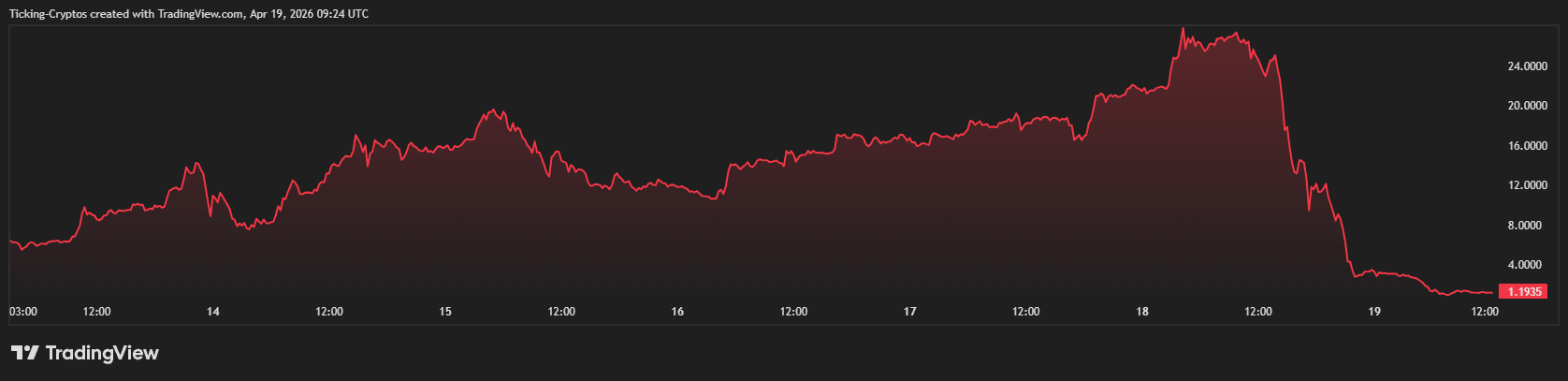
If you were holding $RAVE when this happened, you already know the worst part: there was no time to react. Liquidity dried up faster than the price fell, which meant sell orders were either filling at catastrophic slippage or not filling at all. By the time most holders realized what was happening, the damage was already done.
Was the RAVE Crash Insider Manipulation?
So what actually triggered this? The short answer: it's looking more and more like the insiders got out while everyone else got stuck.
On-chain investigator ZachXBT flagged it almost immediately. Wallet data shows that addresses linked to the RaveDAO deployer moved large amounts of $RAVE onto exchanges — Bitget and Binance specifically — right before the token peaked. The timing is hard to explain away as coincidence.
This has reignited a conversation that keeps coming up in crypto and never really gets resolved: why are major exchanges listing tokens where 90% of the supply sits in a handful of wallets, with no meaningful vesting schedule? Critics are calling the $RAVE listing "ridiculous," and it's hard to disagree. When the token's distribution looks like that, retail traders aren't participants — they're exit liquidity.
As one TradingView analyst put it: when most of the supply is insider-controlled and there's no lock-up in place, the listing itself becomes the dump.
RaveDAO Price Drop: Retail Trap or Pro Trading Opportunity?
For the average retail buyer who jumped in on the hype? $RAVE was a textbook trap. A pump driven by exchange listing momentum, thin liquidity, and concentrated supply. The kind of setup that always ends the same way.
But for experienced traders who read the signs early? This was one of the best short opportunities of the year. We'd already pointed out the red flags in our earlier analysis — the volume-to-market-cap ratio was at levels that screamed unsustainable, and the insider concentration made the downside thesis almost too obvious. Traders who positioned short before the unwind turned what was a disaster for most into a seriously profitable trade.
That's the uncomfortable truth about crypto: the same event that wrecks one person's portfolio can fund someone else's.
RAVE Price Prediction: Is a Dead Cat Bounce Coming?
Even after a 95% collapse, $RAVE isn't going quietly. The volatility alone is keeping it on every trader's watchlist, and history tells us that tokens that drop this hard, this fast, tend to produce a mechanical bounce.
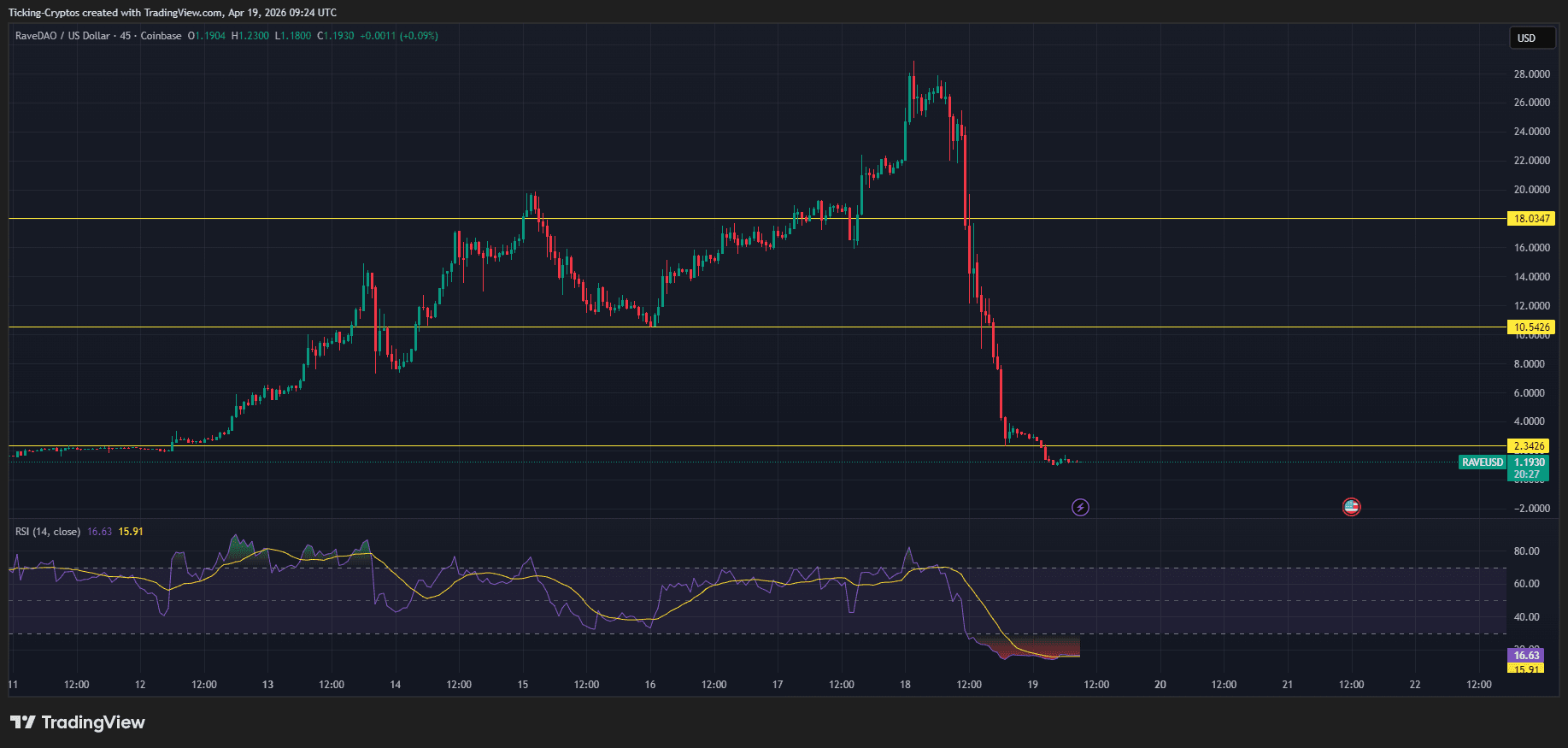
Here's the logic: shorts start taking profit, bottom-fishers and degens pile in at what looks like a psychological floor, and for a brief window, the price snaps back up — hard. Not because the fundamentals have changed, but because that's just how markets behave after extreme moves.
Our expectation: a relief rally somewhere in the range of 80% to 100% from the lows, potentially within the next 24 to 48 hours.
But we want to be very clear — this is not a recovery play. It's a mechanical reaction in a market that's been heavily manipulated. If you're trading this bounce, you need a plan, a stop loss, and the discipline to take profit before the next leg down. This is not a token you hold and hope with.
Crypto Trading Volatility: How to Protect Yourself After the RAVE Collapse
If there's one takeaway from the $RAVE collapse, it's this: a CEX listing is not a stamp of quality. Binance listing something doesn't mean it's safe. Bitget listing something doesn't mean the tokenomics are sound. Exchanges are businesses — they list what drives volume, not necessarily what protects traders.
So if you're a retail investor, the lesson is straightforward. Check the supply distribution before you buy. Look at vesting schedules. Ask yourself who's already in and what their exit plan looks like. And if you're sitting on crypto you want to protect, take a look at our hardware wallet comparison — keeping your keys offline is still the simplest way to avoid losing funds to something you didn't see coming.
For professional traders, this is just another chapter. The chart is still moving, the volatility isn't going anywhere, and where there's volatility, there's opportunity. Follow the data, size your positions carefully, and whatever you do — don't fall in love with the trade.















 English (US) ·