
 2 hours ago
1
2 hours ago
1
Interpol said a crypto wallet linked to a 20-year-old fraud suspect processed more than $122.5 million over 10 months.
Police in Thailand arrested two people in a money-laundering investigation involving romance-scam proceeds moved through crypto and cross-chain token swaps. The swaps were used to obscure the financial trail, Interpol said in a July 9 account of Operation First Light 2026.
The $122.5 million reflects money that passed through the wallet over 10 months, rather than a balance sitting there at once. Interpol did not identify the wallet, name the assets or chains used, say how much of the total came from theft, or disclose how much Thai authorities recovered.
The case was one part of a coordinated operation spanning 97 countries and territories. Interpol reported 5,811 arrests, $293 million in intercepted illicit assets, and more than 142,000 identified victims.
Cross-chain swaps raise the tracing burden
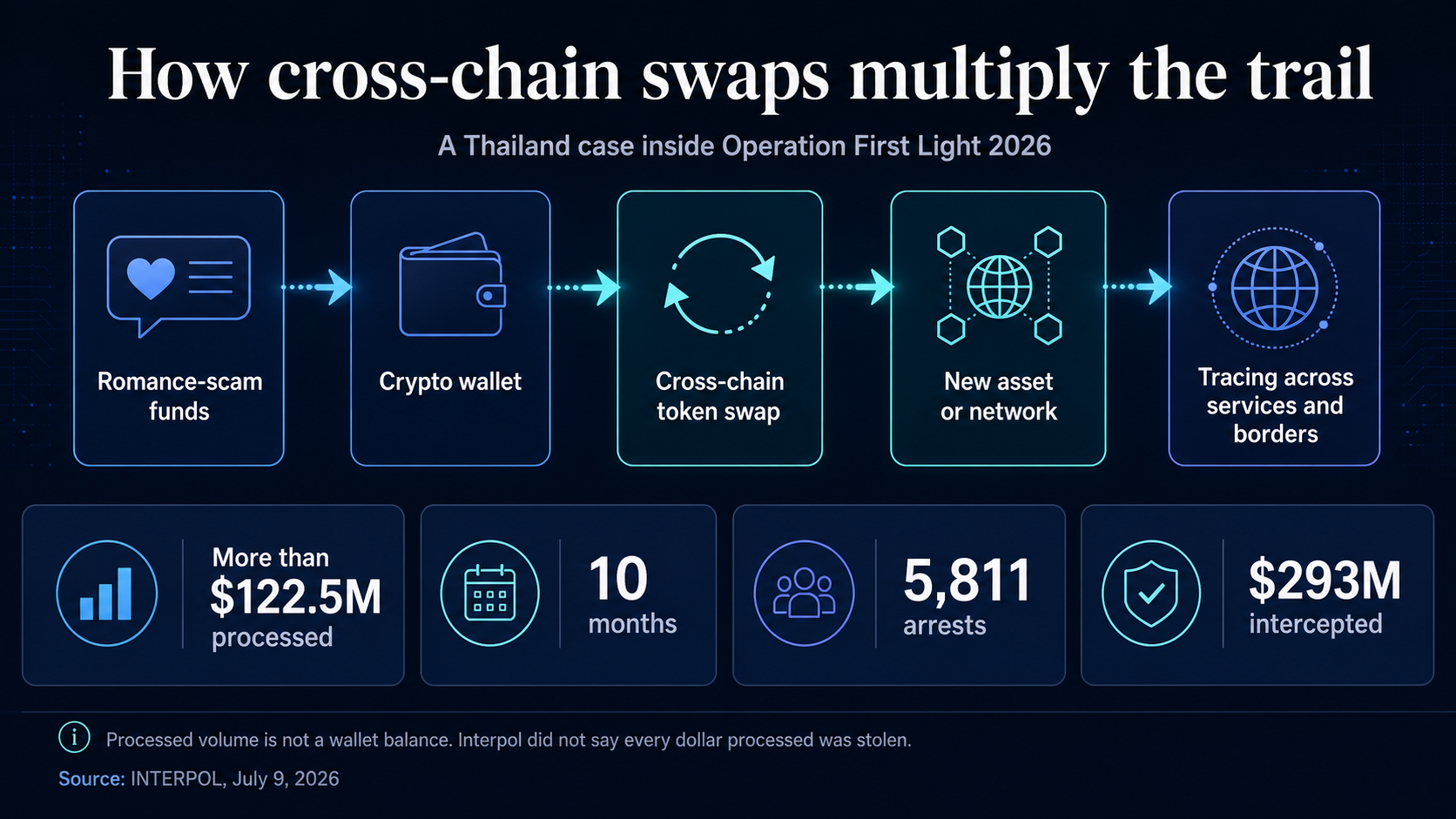
A token swap can push funds from one asset or blockchain into another. Once a laundering trail spans multiple chains, investigators must piece together records from different ledgers and services before the money reaches an off-ramp tied to a real-world identity.
Using cross-chain swaps means each transition adds another technical and legal handoff to an investigation, especially when funds pass through peer-to-peer wallets or services with different recordkeeping and compliance controls.
The Financial Action Task Force said in a March 2026 report that cross-chain activity can fall outside some counter-illicit-finance controls. It called for law-enforcement and supervisory bodies to build expertise in cross-chain mechanics, smart contracts and blockchain analytics, alongside stronger monitoring of peer-to-peer risks.
Thailand shows how quickly that policy concern becomes an enforcement problem. Any company along a cross-chain route, from wallets and exchanges to swap services and analytics firms, may be expected to keep records authorities can use and flag suspicious flows before the trail goes cold.
Operation First Light combined intelligence exchange with raids, account and wallet freezes, Interpol notices, and requests through I-GRIP, a mechanism designed to block illicit flows in fiat and virtual assets.
The operation ran from Jan. 15 through April 30 after an initial intelligence-gathering period. Its results show that enforcement agencies can disrupt large fraud networks, but the Thailand case also highlights the next pressure point: tracing value quickly enough as it changes hands across chains before investigators can act.
















 English (US) ·