
 1 hour ago
2
1 hour ago
2
Intel just went from Silicon Valley’s most pitied company to the centerpiece of America’s semiconductor strategy. The US government now owns a 10% equity stake in the chip maker, converted from roughly $9 to $10 billion in CHIPS Act funding, and it’s actively pressuring the biggest names in tech to route their manufacturing through Intel’s fabs.
The deal structure and what’s actually happening
The arrangement works like this: the federal government converted its CHIPS Act support into direct equity ownership in Intel, giving taxpayers a meaningful stake in whether the company succeeds. On top of that 10% position, an additional $10 billion has been earmarked for investment in US-based factories.
President Trump announced on June 18 that Apple had agreed to collaborate with Intel on US-based chip design and production. The move is specifically designed to reduce Apple’s near-total dependence on Taiwan Semiconductor Manufacturing Company, which currently dominates the world’s most advanced chip fabrication.
Nvidia is also in the mix, with a reported $5 billion involvement in manufacturing partnerships with Intel. CEO Lip-Bu Tan has been working to line up several major customers, turning Intel from a company that lost the mobile revolution into one that could anchor America’s AI hardware supply chain.
Why the government is playing matchmaker
Taiwan sits roughly 100 miles off the coast of China. TSMC, headquartered in Taiwan, manufactures the vast majority of the world’s most advanced semiconductors. Every iPhone chip, every Nvidia GPU, every cutting-edge processor for AI workloads: nearly all of them flow through a single island in one of the most geopolitically sensitive regions on Earth.
The pressure campaign extends beyond gentle suggestions. The administration has been actively pushing Apple, Nvidia, and other major buyers to commit to Intel’s foundry services. This isn’t a free market decision in the traditional sense. It’s policy-driven demand creation, with the government using its leverage as both a regulator and now a shareholder to steer purchasing decisions.
Intel’s turnaround under Lip-Bu Tan
Lip-Bu Tan took the CEO role with a mandate to fix the foundry business and make Intel competitive again in contract manufacturing. The government partnerships give him something his predecessors didn’t have: guaranteed demand from the biggest chip buyers on the planet, backed by federal dollars and geopolitical urgency.
The Apple partnership is particularly significant. Apple spent years designing its own chips and having them manufactured by TSMC, a strategy that produced the M-series processors widely regarded as industry-leading.
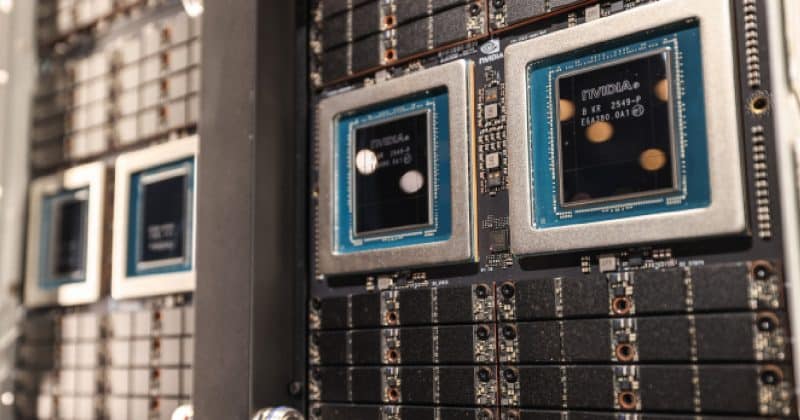
For Nvidia, the partnership addresses a different problem. As AI chip demand explodes, Nvidia has been capacity-constrained at TSMC. Adding Intel as a manufacturing partner gives Nvidia more production flexibility, even if Intel’s process technology isn’t yet at parity with TSMC’s most advanced nodes.
What this means for investors
The investment thesis for Intel has fundamentally changed. Government backing reduces the chance of Intel running out of runway before its manufacturing improvements bear fruit. The committed factory investments provide capital that Intel wouldn’t have been able to raise on comparable terms in public markets given its recent track record.
Policy-driven demand isn’t the same as market-driven demand. If Intel’s manufacturing quality doesn’t meet the standards Apple and Nvidia require, these partnerships could produce chips that nobody actually wants to use in volume. Government equity stakes also introduce political risk: changes in administration could shift priorities, and Congressional scrutiny of the investment’s returns will intensify over time.
Disclosure: This article was edited by Editorial Team. For more information on how we create and review content, see our Editorial Policy.











 English (US) ·