
 1 month ago
19
1 month ago
19
Today in crypto, Coinbase said it will cut about 14% of its workforce, members of the US banking industry expressed dissatisfaction with the newly-proposed stablecoin provisions in the CLARITY Act, and the US Depository Trust & Clearing Corporation announced a plan to pilot tokenized securities.
Coinbase cuts 14% of workforce, citing market slump and AI shift
Coinbase will cut about 14% of its workforce, or roughly 700 jobs, as CEO Brian Armstrong moves to make the crypto exchange leaner and more focused on artificial intelligence.
Armstrong said in an email to employees that Coinbase is responding to two forces at once: a down market that pressured the company's quarter-to-quarter business and rapid advances in AI that are changing how teams work.
He said the company will flatten its organizational structure to a maximum of five layers below the CEO and chief operating officer, require leaders to act as “player-coaches” rather than pure managers and concentrate around smaller AI-native teams that can use automated tools to increase output.
“To those affected, we will be providing a comprehensive package to support you through this transition,” Armstrong said, saying that it will include at least 16 weeks of base pay for US employees, additional pay based on tenure, their next equity vest and six months of “COBRA” or the “Consolidated Omnibus Budget Reconciliation Act,” a US program that allows former employees to temporarily continue employer-sponsored health insurance coverage.
A Tuesday filing with the US Securities and Exchange Commission showed that Coinbase expects its restructuring plan to incur about $50 million to $60 million in expenses tied to severance and termination benefits. The company expects the plan to be substantially complete in the second quarter of 2026.
The cuts show Coinbase framing AI not only as a productivity tool, but as a reason to rethink staffing, management and team structure across one of the largest US crypto companies.
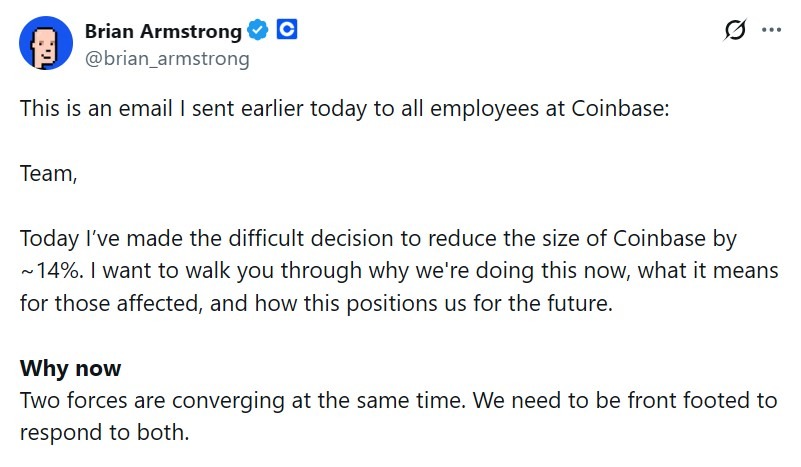
Source: Brian Armstrong
Stablecoin proposal still "falls short" of protecting bank deposits: US banks
America’s largest banking groups said they remain dissatisfied with the CLARITY Act’s newly proposed language on stablecoin yield, arguing that it fails to protect bank deposits.
In a statement on Monday, the bankers acknowledged that US Senators Thom Tillis and Angela Alsobrooks are “seeking to achieve the correct policy goal” in prohibiting stablecoin yield but noted that the CLARITY Act’s “proposed language” currently “falls short of that goal.”
“It is imperative that Congress get this right,” the American Bankers Association said in a joint statement with the Bank Policy Institute, Consumer Bankers Association, Financial Services Forum and Independent Community Bankers of America.
The dispute between bankers and the crypto industry over stablecoin yield has stalled the bipartisan bill, which passed the House of Representatives in July by a 294-134 vote. There are concerns that the CLARITY Act may not pass before the US midterm elections in November 2026, which could further hinder its progress.
Banking groups have previously cited studies suggesting that widespread stablecoin adoption could lead to trillions in outflows from the US banking system, particularly from community banks, which may not have enough balance-sheet flexibility to absorb these outflows without resorting to higher-cost wholesale borrowing.
In the Monday statement, the bankers also cited an article by Stanford-trained economist Andrew Nigrinis to argue that stablecoin yields driving bank deposit outflows “could reduce all consumer, small-business, and farm loans by one-fifth or more, making it essential for the prohibition to be clear and transparent.”
However, White House economists reported in April that banning stablecoin yield may increase bank lending by only $2.1 billion, a marginal net increase of about 0.02%.
DTCC eyes October tokenized securities launch with 50 DeFi and TradFi giants
The Depository Trust & Clearing Corporation (DTCC) plans to pilot trading of tokenized securities in July with a goal of a full service launch in October.
The post-trade market infrastructure giant said Monday that more than 50 TradFi and DeFi firms will play a role in the design and deployment of the service. That DTCC Industry Working Group includes Alpaca, Anchorage Digital, BitGo Bank & Trust, BlackRock, Circle and Fireblocks, along with some of the biggest banks in the country.
DTCC, which currently custodies $114 trillion in liquid assets from stocks to exchange-traded funds, said it expects the service will enable tokenization of real-world assets that provide the same entitlements, investor protections and ownership rights as the assets held in traditional form.
While the pilot phase will test limited production trades, the full service is expected to tokenize a specific set of some of the most-widely traded liquid assets, including exchange-traded funds tracking major indexes, Russell 1000 constituents, US Treasury bills, bonds and notes, according to DTCC’s announcement.

Source: DTCC
SEC delays prediction market ETFs over mechanics and risk concerns: Report
The SEC has delayed the expected launch of the first ETFs linked to prediction markets after requesting more information about their structure and disclosures, Reuters reported Monday.
The delay affects more than two dozen proposed ETFs from Roundhill Investments, GraniteShares and Bitwise, according to Reuters, citing people familiar with the matter. The issuers filed for the products in February, and launches had been expected this week after a 75-day review period.
The proposed funds would give investors exposure to event contracts tied to binary outcomes, including elections, economic data and market prices, without requiring them to trade directly on prediction market venues such as Kalshi.
The delay marks another development in the US approach to regulating prediction markets, which have attracted scrutiny over insider trading, ethics and market manipulation concerns.
According to the sources cited by Reuters, the delay is likely temporary, suggesting that progress with the filings could resume once the SEC receives and reviews additional details from issuers on product structure and disclosures.
According to Bloomberg ETF analyst Eric Balchunas, the ETFs were expected to launch on Thursday. His colleague James Seyffart last week said Roundhill’s filing had an effective date of May 5, with the first prediction market ETFs linked to event-contract outcomes such as whether Democrats or Republicans control the House or Senate.

Source: James Seyffart
Cointelegraph is committed to independent, transparent journalism. This news article is produced in accordance with Cointelegraph’s Editorial Policy and aims to provide accurate and timely information. Readers are encouraged to verify information independently.














 English (US) ·