
 1 month ago
36
1 month ago
36
Here’s a new mobile browser you’ll actually want to use. The BSV Browser, launched with official BSV Association endorsement, combines web browsing with identity management and built-in payments. The often-promised world of Web3 is finally becoming an easy-to-use reality.
- BSV Browser: A new browsing experience
- BRC-100 is emerging as a standard for Web3
- Practical and secure for browsing, and payments
The browser does everything you’d expect from a regular “Web 2.0” browser, but it also complies with the BRC-100 Wallet Interface standard, letting it access a richer world of blockchain-based services directly. BRC-100 is becoming a de facto standard for interoperability across the BSV ecosystem, meaning users can use the same wallet for payments, login credentials, and trust networks.
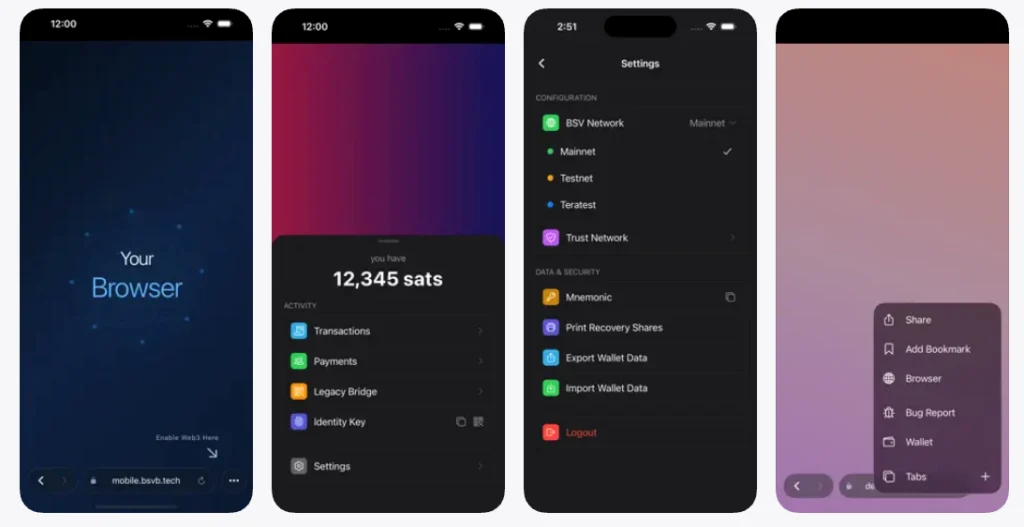 Source: Apple Store
 BSV Association threw some weight behind the initiative with funding and support to get development up and running. Babbage built the TypeScript SDK and library repos including the Wallet Toolbox, with about 12 developers working to build what eventually became two separate mobile apps. In 2026, Darren “Deggen” Kellenschwiler designed and completed BSV Browser’s final product.
BRC-100 as an emerging Web3 standard
The BRC-100 specification defines how web applications communicate with wallets, establishing a common language for transaction requests, signatures, encryption operations, and identity verification.
This reduces friction for future developers. Rather than having to build wallet infrastructure themselves or requiring users to install specific extensions, they can rely on the BRC-100 interface. Compliant browser implementations will handle any cryptographic operations. For users, it means consistent interactions across different BSV-based services.
BSV Browser’s code is open source and can be used as a reference release for anyone wanting to create their own implementation. In fact, BSVA actively encourages other developers to do so.
“It was always the intention to have vendor neutrality, which means we would be quite happy for other businesses to fork this code and build their own wallet branded however they like,” Kellenschwiler said. “They also could just focus on developing business applications, and there is no risk of their app breaking,” if another wallet app provider goes out of business.
The BSV Browser is self-custodial, meaning users always hold their own keys and wallet funds. Keys are derived from a 12-word BIP-39 mnemonic stored locally on the device using secure storage systems. No data is transmitted to BSV Association or third parties.
BSV Association emphasizes this point clearly on its FAQ page: browsing history, wallet keys, and personal data remain on the user’s device.
Notably, Apple allows iOS users the choice to set BSV Browser as their device’s default browser. It’s one of the very few browser apps with this privilege thanks to its standalone nature, and it performs wallet seed-generation on the device.
If you aren't browsing with a self-custodial wallet in 2026, you're doing it wrong. This is seamless.
— Byte Reaper (@ReapTheByte) March 24, 2026Kellenschwiler said it had been his goal for over three years for Bitcoin to have a true mobile wallet with direct instant payments, and that he’d designed BSV Browser’s interface to have a “simple and beautiful user experience.”
After downloading and testing the app ourselves, we can attest that BSV Browser is both simple and beautiful. Onboarding is swift, with options to create a brand new wallet or import an existing one. Locating and saving the 12-word wallet seed was also easier than it would be for other blockchain apps.
Practical and secure for browsing, and payments
The browser supports several payment mechanisms. Through its Payments screen, users can send BSV directly to others using identity-based resolution rather than raw blockchain addresses. You search for recipients by name across the BSV identity network. For compatibility with existing wallets and exchanges, a “Legacy Bridge” handles traditional address-and-QR-based transactions.
Micropayments feature prominently in the design. BSV’s low transaction fees and high-volume throughput make sub-cent payments practical, and the browser’s permission system allows websites to request small payments for specific actions, such as accessing content, saving data, or triggering on-chain events. Each request triggers an approval page that shows users the exact amount in satoshis (with the fiat equivalent).
Identity management operates without usernames or passwords. The browser generates a unique identity key from the wallet seed, enabling mutual authentication between users and applications. Certificate support enables selective disclosure of identity attributes, e.g., verifying age without revealing birthdates or confirming organizational membership without exposing full identity details.
Users can also split their wallet’s private keys into three shares using Shamir’s Secret Sharing. Whether you need this level of security or would just like to engage in some gratuitous spycraft, it’s easy to do.
The release marks progress toward mainstream accessibility for BSV-based services and Web3. By embedding wallet functionality into a tool users already understand, like a web browser, BSV Association is removing a significant adoption barrier. Users don’t need to learn new interfaces or manage multiple applications to access BSV-enabled websites.
As blockchain-enabled Web3 services continue to develop, apps that reduce friction between traditional browsing habits and decentralized functionality will likely play an important role in determining which platforms gain user traction. The BSV Browser enters this space with a simple proposition: one application for both reading the web and interacting with it economically.
Watch | Tokenization on Public Blockchain: Transforming RWAs and Finance















 English (US) ·