
 1 hour ago
2
1 hour ago
2
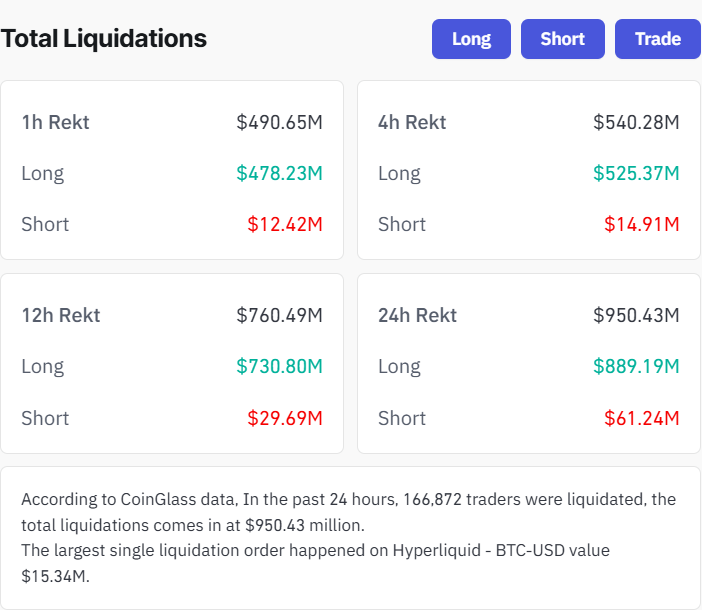
Bitcoin slid under $73,000 on Wednesday to its weakest price since April, wiping out more than $950 million in liquidations across leveraged crypto positions in a single day.
Most of the losses came from bullish traders, with long positions accounting for $889 million of the total liquidations.
 Source: CoinGlass
Investor sentiment is facing increased volatility amid mounting macro and geopolitical uncertainty following renewed military exchanges between Iran and the US on Wednesday. Both sides launched attacks despite an existing ceasefire agreement.
Iran’s Revolutionary Guard claimed responsibility for an attack on a US military base after Washington carried out strikes near Bandar Abbas, where US forces reportedly downed Iranian drones and hit a control facility. Kuwait separately said it intercepted multiple aerial threats, including missiles and drones.
The latest escalation has intensified concerns about the security of the Strait of Hormuz, one of the world’s most important energy transit corridors.
As Bitcoin broke down, the altcoin market suffered a severe capital flush.
Ethereum fell below $2,000 for the first time since late March, while BNB dropped under $640 and XRP slid beneath $1.28. The total crypto market cap declined around 2.5% in the past day to $2.5 trillion.
ETF flows reversed hard
Elsewhere, continued outflows from US spot-Bitcoin ETFs and reports of a major sale linked to BlackRock’s iShares Bitcoin Trust have added further pressure to crypto prices.
The group recorded roughly $733 million in net outflows on Wednesday, with IBIT accounting for the majority after posting approximately $528 million in net losses, per Farside Investors.
US spot-Bitcoin ETFs have now seen around $2 billion in net outflows in May, even as US equities continue rallying on optimism surrounding artificial intelligence.
Geopolitics and rate expectations
Concerns around the ongoing US-Iran conflict have stoked fears about energy prices and, by extension, inflation. If energy costs push consumer prices higher, the Federal Reserve faces pressure to raise interest rates rather than cut them.
Minutes from the Fed’s April meeting showed policymakers growing more hawkish. Several officials indicated that rates could rise if inflation fails to cool. Markets are increasingly pricing in a prolonged restrictive policy, tightening liquidity conditions for digital assets and overall risk markets.
Disclosure: This article was edited by Vivian Nguyen. For more information on how we create and review content, see our Editorial Policy.














 English (US) ·