
 2 hours ago
2
2 hours ago
2
A grim narrative is making the rounds in crypto circles: that Bitcoin ($BTC) is fundamentally broken, that AI and quantum computing have signed its death warrant, and that the price could collapse toward $16,000 or lower. With Bitcoin already bruised below $60,000 after a brutal sell-off, the fear is spreading fast.
So is the "death of Bitcoin" thesis real, or is this just the latest cycle of extreme FUD? Let's break down the actual argument behind the crash call — and then weigh it against what the evidence really shows.
What is the bear case behind a $16K Bitcoin?
The most aggressive bear thesis ties together several threads into one dark picture. The argument goes roughly like this: encryption is on borrowed time, anonymity is already gone thanks to mass data collection and chain-surveillance, and the combination of AI and quantum computing will eventually crack the cryptography Bitcoin depends on. In that framing, Bitcoin's core value proposition — censorship resistance and cryptographic security — is fatally undermined, and the price simply reflects a slow realization that the "case for Bitcoin is dead."
It's worth being clear: a $16,000 target is not a mainstream analyst forecast. It sits at the extreme end of the bear spectrum. The most pessimistic credible published views are far less severe — veteran trader Peter Brandt has warned that if Bitcoin's parabolic advance is truly broken, BTC could face declines exceeding 80% from peak levels, potentially as low as $25,000, which represents the most bearish outlook in the current forecast landscape. Even on-chain bears land higher than $16K — analyst Ki Young Ju has argued that history, if it rhymes, puts a worst-case scenario somewhere near or below $30,000.
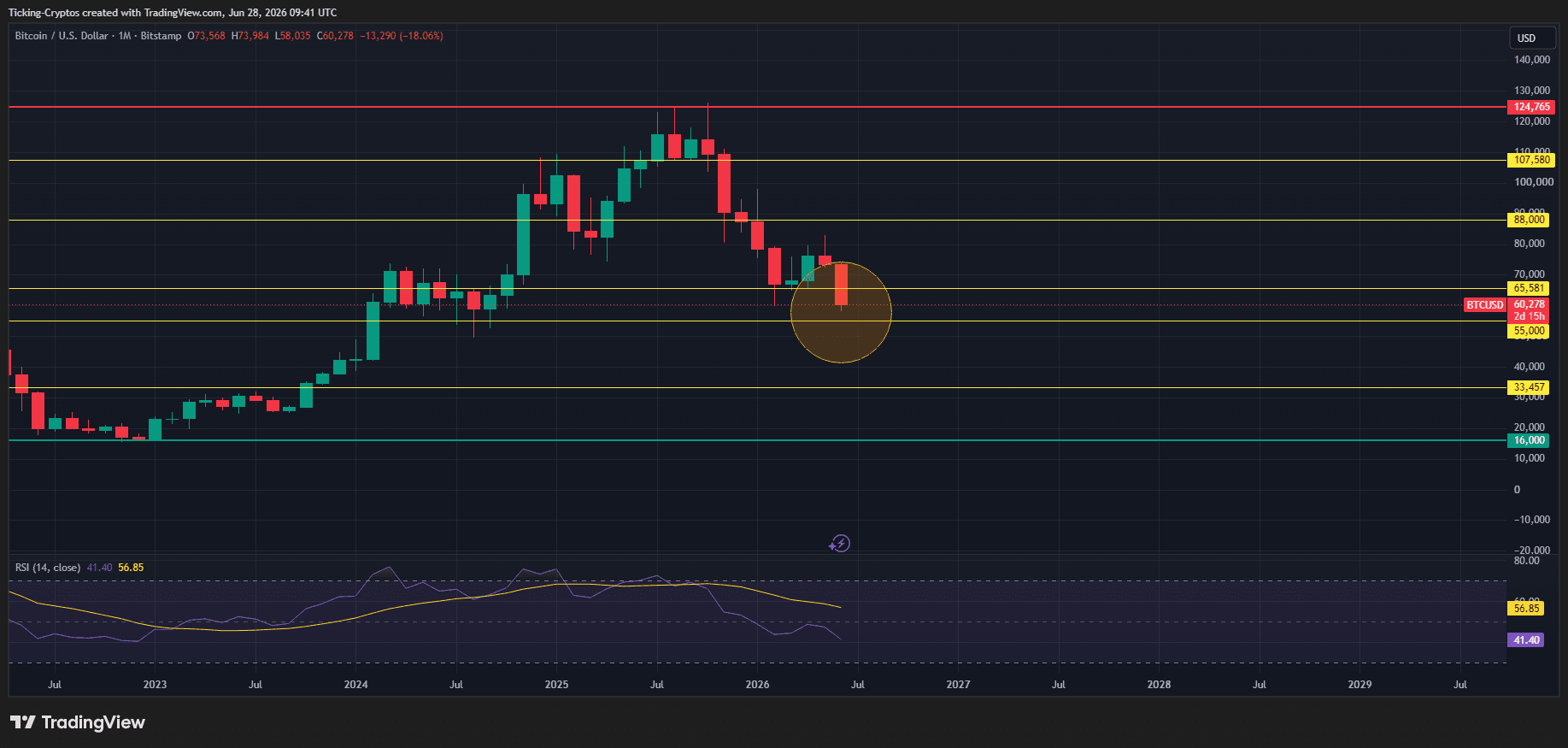
In other words, $16K is a narrative-driven doom number, not something the data-driven bears are modeling.
Is the quantum and AI threat to Bitcoin real?
Here's where it gets nuanced: the underlying fear isn't pure fantasy. There is a genuine, active debate about quantum computing and AI as long-term threats to crypto cryptography.
The catalyst was a major piece of research. On March 31, 2026, Google's Quantum AI team published a whitepaper showing that breaking the elliptic curve cryptography protecting Bitcoin could require 20× fewer quantum resources than estimated in 2019 — fewer than 500,000 physical qubits — and identified roughly 6.9 million BTC (about 32% of supply) in wallets with exposed public keys. That's a real, fixed pool of vulnerable coins.
AI is the accelerant in this story. Security researchers warn that AI is accelerating the development of quantum computing, creating a new cybersecurity arms race, and an AI model recently uncovered a four-year-old bug in Zcash that could have enabled unlimited token issuance, triggering a steep sell-off and intensifying fears that AI will expose hidden vulnerabilities across crypto. The concern that "AI killed Bitcoin" stems partly from this — the idea that machine learning compresses the timeline on threats that once felt decades away. As one observer put it, the synergy has shifted quantum from a "physics problem" to an "engineering challenge."
There's also a real concern about harvested data. State actors are almost certainly collecting blockchain data today, planning to decrypt it once quantum hardware matures — and the 6.9M exposed BTC are fixed targets. That's the kernel of truth behind the "anonymity is gone through collected data" claim.
Why the "Bitcoin is dead" thesis is likely overblown
Now for the other side — and it's a strong one. The expert consensus is that this threat is real but not imminent, and that Bitcoin has ample time to adapt.
On the hardware timeline, the gap is enormous. ARK Invest concluded in March 2026 that we're still at "Stage 0" — quantum computers exist but lack any commercially relevant capability — and the most optimistic hardware projections don't place us at 500K qubits before 2033–2035. Some of the most respected voices in cryptography are even more dismissive of near-term panic. Blockstream CEO and cypherpunk Adam Back argues a cryptographically relevant quantum threat is likely 20 to 40 years away, emphasizing that Bitcoin's security is about digital signatures, not just encryption, and that the network has ample time to integrate quantum-secure signature schemes.
Crucially, most Bitcoin isn't even exposed in the way the doom thesis implies. The threat depends on whether a public key is visible: modern hashed addresses (P2PKH and SegWit) don't reveal public keys until the moment a transaction is broadcast, so those coins are not quantum-vulnerable until spent — and never reusing an address leaves only a tiny window to crack a key.
And the network is already hardening. BIP-360, which introduces a quantum-resistant address type, was merged into Bitcoin's official repository in February 2026, with a testnet implementation already live across 50+ miners. The experts' bottom line is blunt: the consensus among Google, ARK Invest and most cryptographers is that quantum attacks are not imminent — the advice is to move to modern address types and support the migration, not to panic sell.
So what's really driving the Bitcoin crash?
If the "AI killed Bitcoin" story is overblown, why is the price actually down? The real drivers are far more mundane — and far more familiar.
The current sell-off has two main engines. The first is the mechanical cycle, where late leverage gets flushed, sentiment collapses, and everyone declares Bitcoin dead — it happens every time. The second is AI, but as a capital-rotation story: since April, memory chip ETFs pulled in $12.7 billion while Bitcoin ETFs bled over $2 billion. People sold Bitcoin to buy AI stocks. That's the key distinction — AI is hurting Bitcoin by competing for capital, not by breaking its cryptography.
Sentiment did the rest. For years the narrative was that Strategy's Michael Saylor never sells; the moment he did sell a tiny fraction, the market treated it like a five-alarm fire, and roughly $1.6 billion in leveraged positions were liquidated in the cascade that followed. None of that is about quantum computers — it's classic FUD and forced selling.
Tellingly, the smart money is doing the opposite of panicking. The MVRV-Z score sits deep in the accumulation zone, and long-term holders just posted their largest 30-day accumulation on record — buying more aggressively right now than at any point in Bitcoin's history.
Will Bitcoin Price Continue Crashing?
Could Bitcoin fall further? Absolutely. The credible bear cases see real downside risk, with targets clustering anywhere from the mid-$50Ks down to $25K–$30K in worst-case scenarios, driven by ETF outflows, AI capital rotation, and broken bull narratives. That's a genuine risk worth respecting.
But a crash to $16,000 driven by "AI and quantum killing Bitcoin" is a narrative running well ahead of the evidence. The quantum threat is real but years — likely a decade or more — away, most BTC isn't exposed, and the network is already upgrading its defenses. Meanwhile the long-term holders who've survived every prior "Bitcoin is dead" cycle are accumulating, not capitulating.
The honest takeaway: separate the genuine macro risk (which is real) from the doom narrative (which is mostly fear). Respect the downtrend, manage your risk, and don't make decisions based on a "death of Bitcoin" thesis that the actual cryptographers say is decades premature.














 English (US) ·